Battle of Hampton Roads
|
|
|
|
|
|
|
|
Battle of Hampton Roads |
|
||
|
|
|
|
||
|
|
|
|
|
|
|
|||||
|
|
||||
|
|||||
|
|||||||||||||||||||||||||
|
|
Other Names: Monitor vs. Virginia; Monitor--Merrimack Battle;
Duel of the Ironclads
Location: Hampton Roads, Virginia
Campaign: Peninsula Campaign (March-September 1862)
Date(s): March 8-9,
1862
Principal Commanders: Lt. John Worden [US]; Capt. Franklin Buchanan
and Lt. Catesby R. Jones [CS]
Forces Engaged: 4 warships [US]; 1 warship [CS]
Estimated Casualties: 433 total (US 409; CS 24)
Result(s): Inconclusive
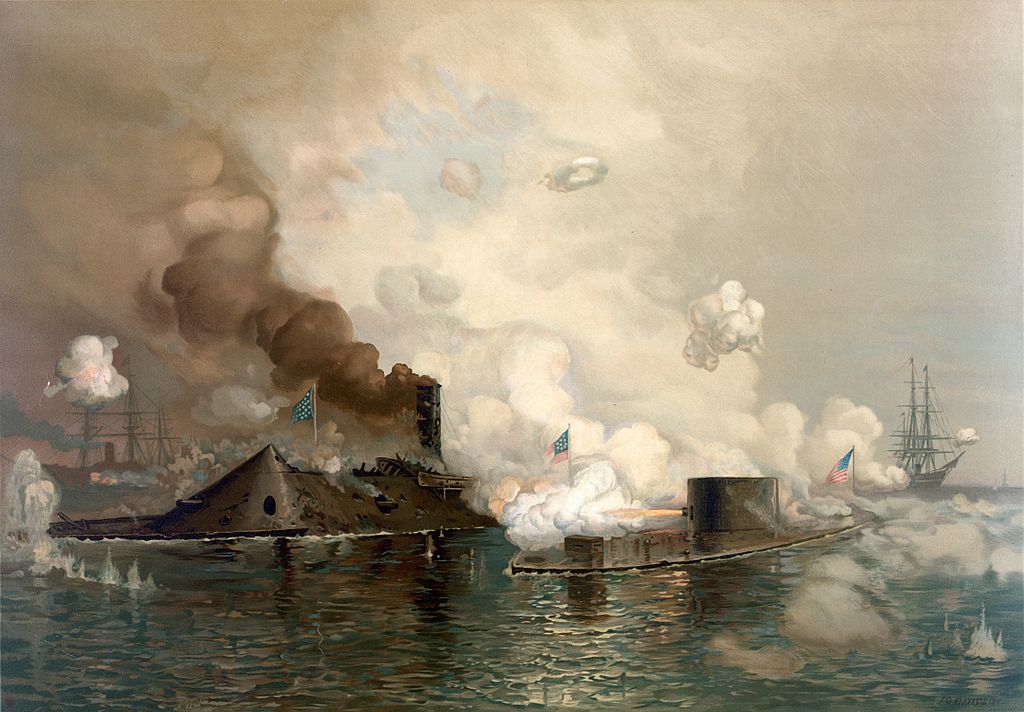
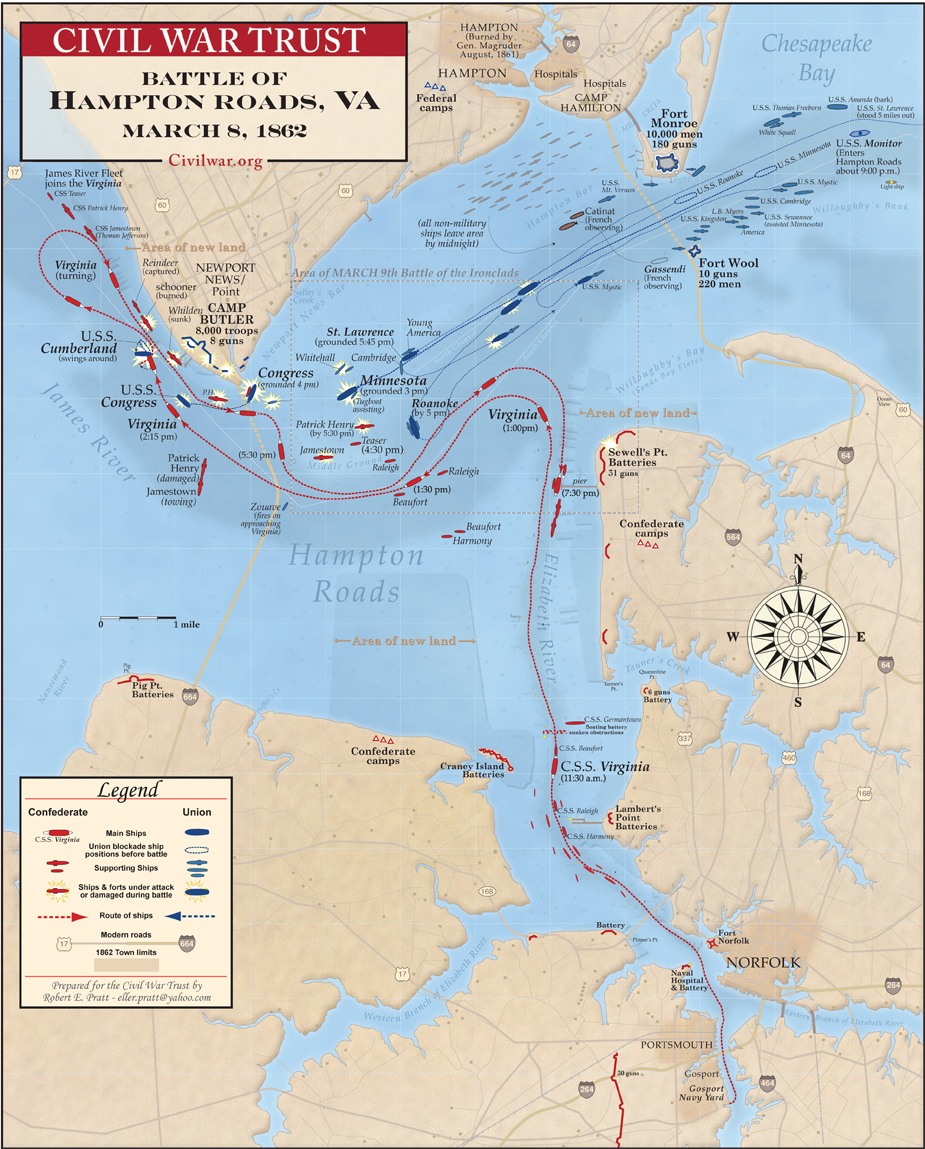
Summary: On March 8, 1862, from her berth at Norfolk, the Confederate
ironclad Virginia steamed into Hampton Roads where she sank Cumberland and ran Congress aground. On March 9, the Union ironclad
Monitor having fortuitously arrived to do battle, initiated the first engagement of ironclads in history. The two ships fought
each other to a standstill, but Virginia retired.
The major significance
of the battle is that it was the first meeting in combat of ironclad warships. The Confederate fleet consisted of the ironclad
ram CSS Virginia (built from the remnants of the USS Merrimack) and several supporting vessels. On the first day of battle,
they were opposed by several conventional, wooden-hulled ships of the Union Navy. On that day, Virginia was able to destroy
two ships of the Federal flotilla, USS Congress and USS Cumberland, and was about to attack a third, USS Minnesota, which
had run aground. However, the action was halted by darkness and falling tide, so Virginia retired to take care of her few
wounded — which included her captain, Flag Officer Franklin Buchanan — and repair her minimal battle damage. Determined to complete
the destruction of the Minnesota, Catesby ap Roger Jones, acting as captain in Buchanan's absence, returned the ship to the
fray the next morning, March 9. During the night, however, the ironclad USS Monitor had arrived and had taken a position to
defend Minnesota. When Virginia approached, Monitor intercepted her. The two ironclads fought for about three hours, with
neither being able to inflict significant damage on the other. The duel ended indecisively, Virginia returning to her home
at the Gosport Navy Yard for repairs and strengthening, and Monitor to her station defending Minnesota. The ships did not
fight again, and the blockade remained in place. The battle received worldwide
attention, and it had immediate effects on navies around the world. The preeminent naval powers, Great Britain and France,
halted further construction of wooden-hulled ships, and others followed suit. A new type of warship was produced, the monitor,
based on the principle of the original. The use of a small number of very heavy guns, mounted so that they could fire in all
directions was first demonstrated by Monitor but soon became standard in warships of all types. Shipbuilders also incorporated
rams into the designs of warship hulls for the rest of the century. At this time, the Union
Navy had five warships in the roadstead, in addition to several support vessels. The sloop-of-war USS Cumberland and frigate
Congress were anchored in the channel near Newport News. Frigate St. Lawrence and the steam frigates Roanoke and Minnesota
were near Fort Monroe, along with the storeship USS Brandywine (1825). The latter three got under way as soon as they saw
Virginia approaching, but all soon ran aground. St. Lawrence and Roanoke took no further important part in the battle. Virginia headed directly
for the Union squadron. The battle opened when Union tug Zouave fired on the advancing enemy, and Beaufort replied. This preliminary
skirmishing had no effect. Virginia did not open fire until she was within easy range of Cumberland. Return fire from Cumberland
and Congress bounced off the iron plates without penetrating. Virginia rammed Cumberland below the waterline and she sank
rapidly, "gallantly fighting her guns as long as they were above water," according to Buchanan. She took 121 seamen down with
her; those wounded brought the casualty total to nearly 150. Ramming Cumberland nearly resulted
in the sinking of Virginia as well. Virginia's bow ram got stuck in the enemy ship's hull, and as Cumberland listed and began
to go down, she almost pulled Virginia under with her. At the time the vessels were locked, one of Cumberland's anchors was
hanging directly above the foredeck of Virginia. Had it come loose, the two ships might have gone down together. Virginia
broke free, however, her ram breaking off as she backed away.
Although she had not suffered
anything like the damage she had inflicted, Virginia was not completely unscathed. Shots from Cumberland, Congress, and Union
troops ashore had riddled her smokestack, reducing her already low speed. Two of her guns were disabled and several armor
plates had been loosened. Two of her crew were killed, and more were wounded. One of the wounded was Captain Buchanan, whose
left thigh was pierced by a rifle shot. Meanwhile, the James River
Squadron had turned its attention to Minnesota, which had left Fort Monroe to join in the battle and had run aground. After
Virginia had dealt with the surrender of Congress, she joined the James River Squadron despite her damage. Because of her
deep draft and the falling tide, however, Virginia was unable to get close enough to be effective, and darkness prevented
the rest of the squadron from aiming their guns to any effect. The attack was therefore suspended. Virginia left with the
expectation of returning the next day and completing the task. She retreated into the safety of Confederate-controlled waters
off Sewell's Point for the night, but had killed 400 enemy sailors and had lost two. The Union had lost two ships and three
were aground. The United States Navy's greatest
defeat until World War II caused panic in Washington. As Lincoln's Cabinet met to discuss the disaster, the frightened Secretary
of War Edwin Stanton told the others that the Virginia might attack East coast cities, and even shell the White House before
the meeting ended. Welles assured his colleagues that they were safe as the ship could not traverse the Potomac River. He
added that the Union also had an ironclad, and that it was heading to meet the Virginia. March 9:
Both sides used the respite to prepare for the next day. Virginia put her wounded ashore and underwent temporary repairs.
Captain Buchanan was among the wounded, so command on the second day fell to his executive officer, Lieutenant Catesby ap
Roger Jones. Jones proved to be no less aggressive than the man he replaced. While Virginia was being prepared for renewal
of the battle, and while Congress was still ablaze, Monitor, commanded by Lieutenant John L. Worden, arrived in Hampton Roads.
The Union ironclad had been rushed to Hampton Roads in hopes of protecting the Union fleet and preventing Virginia from threatening
Union cities. Captain Worden was informed that his primary task was to protect Minnesota, so Monitor took up a position near
the grounded Minnesota and waited. “All on board felt we had a friend that would stand by us in our hour of trial,”
wrote Captain Gershom Jacques Van Brunt, the vessel’s commander, in his official report the day after the engagement.
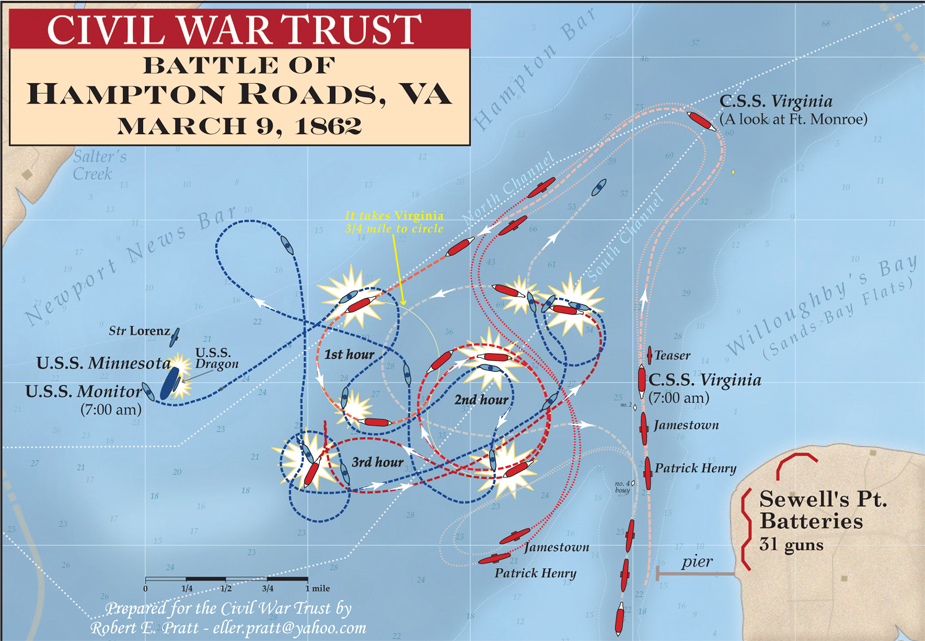
The next morning, at dawn
on March 9, 1862, Virginia left her anchorage at Sewell's Point and moved to attack Minnesota, still aground. She was followed
by the three ships of the James River Squadron. They found their course blocked, however, by the newly arrived Monitor. At
first, Jones believed the strange craft—which one Confederate sailor mocked as "a cheese on a raft"—to be a boiler
being towed from the Minnesota, not realizing the nature of his opponent. Soon, however, it was apparent that he had no choice
but to fight her. The first shot of the engagement, was fired at Monitor by Virginia. The shot flew past Monitor and struck
Minnesota, which answered with a broadside; this began what would be a lengthy engagement. “Again, all hands were called
to quarters, and when she approached within a mile of us I opened upon her with my stern guns and made a signal to the Monitor
to attack the enemy,” Van Brunt added. After fighting for hours,
mostly at close range, neither could overcome the other. The armor of both ships proved adequate. In part, this was because
each was handicapped in her offensive capabilities. Buchanan, in Virginia, had not expected to fight another armored vessel,
so his guns were supplied only with shell rather than armor-piercing shot. Monitor's guns were used with the standard service
charge of only 15 lb of powder, which did not give the projectile sufficient momentum to penetrate her opponent's armor. Tests
conducted after the battle showed that the Dahlgren guns could be operated safely and efficiently with charges of as much
as 30 lb. The battle finally ceased when
a chance shell from Virginia struck the pilot house of Monitor and exploded, driving fragments of paint and iron through the
viewing slits into Worden's eyes and temporarily blinding him. As no one else could see to conn the ship, Monitor was forced
to draw off. The executive officer, Lieutenant Samuel Dana Greene, took over, and Monitor returned to the fight. In the period
of command confusion, however, the crew of Virginia believed that their opponent had withdrawn. Although Minnesota was still
aground, the falling tide meant that she was out of reach. Furthermore, Virginia had suffered enough damage to require extensive
repair. Convinced that his ship had won the day, Jones ordered her back to Norfolk. At about this time, Monitor returned,
only to discover her opponent apparently giving up the fight. Convinced that Virginia was quitting, with orders only to protect
Minnesota and not to risk his ship unnecessarily, Greene did not pursue. Thus, each side misinterpreted the moves of the other,
and as a result each claimed victory.
"The conduct of the
Officers and men of the squadron … reflects unfading honor upon themselves and upon the Navy. The report will be read
with deep interest, and its details will not fail to rouse the ardor and nerve the arms of our gallant seamen. It will be
remembered that the Virginia was a novelty in naval architecture, wholly unlike any ship that ever floated; that her heaviest
guns were equal novelties in ordnance; that her motive power and obedience to her helm were untried, and her officers and
crew strangers, comparatively, to the ship and to each other; and yet, under all these disadvantages, the dashing courage
and consummate professional ability of Flag Officer Buchanan and his associates achieved the most remarkable victory which
naval annals record." In Washington, belief that
Monitor had vanquished Virginia was so strong that Worden and his men were awarded the Thanks of Congress: "Resolved . . . That the thanks
of Congress and the American people are due and are hereby tendered to Lieutenant J. L. Worden, of the United States Navy,
and to the officers and men of the ironclad gunboat Monitor, under his command, for the skill and gallantry exhibited by them
in the remarkable battle between the Monitor and the rebel ironclad steamer Merrimack." During the two-day engagement,
the U.S.S. Minnesota shot off 78 rounds of 10-inch solid shot; 67 rounds of 10-inch solid shot with 15-second fuse; 169 rounds
of 9-inch solid shot; 180 9-inch shells with 15-second fuse; 35 8-inch shells with 15-second fuse and 5,567.5 pounds of service
powder. Three crew members, Alexander Winslow, Henry Smith and Dennis Harrington were killed during the battle and 16 were
wounded. Aftermath:
Each vessel spent the next month in what amounted to posturing. Not only did the two ships not fight each other, neither ship
ever fought again after March 9. The end came first for
Virginia. Because the blockade was unbroken, Norfolk was of little strategic use to the Confederacy, and preliminary plans
were laid to move the ship up the James River to the vicinity of Richmond. Before adequate preparations could be made, the
Confederate Army under Major General Benjamin Huger abandoned the city on May 9, without consulting anyone from the Navy.
Virginia's draft was too great to permit her to pass up the river, which had a depth of only 18 ft, and that only under favorable
circumstances. She was trapped and could only be captured or sunk by the Union Navy. Rather than allow either, Tatnall decided
to destroy his own ship. He had her towed down to Craney Island in Portsmouth, where the gang was taken ashore, and then she
was set afire. She burned through the rest of the day and most of the following night; shortly before dawn, the flames reached
her magazine, and she blew up. Monitor likewise did not survive
the year. She was ordered to Beaufort, North Carolina, on Christmas Day, to take part in the blockade there. While she was
being towed down the coast (under command of her fourth captain, Commander John P. Bankhead), the wind increased and with
it the waves; with no high sides, the Monitor took on water. Soon the water in the hold gained on the pumps, and then put
out the fires in her engines. The order was given to abandon ship; most men were rescued by USS Rhode Island, but 16 went
down with her when she sank in the early hours of December 31, 1862. Battle of Hampton Roads, aka
Battle of the Ironclads or Monitor Merrimack Duel, witnessed the world's first battleships in action as the two armorclad
warships roared and thundered for hours as each fired volley after volley in what appeared to be futile attempts to sink the
other. The Monitor and Merrimack (aka CSS Virginia) battle ushered in a new era of naval warfare and literally made all modern
navies around the globe obsolete. As a result of the Civil War, monitors and ironclad rams would respectfully be known
as the world’s first generation battleships. See also: USS Monitor, USS Merrimack, CSS Virginia, Battle
of Hampton Roads: Homepage and Union and Confederate Navies: Homepage.
|
|
|
|||||||||||||||||||||
|
|||||||||||||||||||||||||
|
|
|
|
|
|
|
|
|
|
|
|
|
|
|
|
|
|||||||||
|
|
|
|
|
|
|
|
|
|
|
|
|
|
|
|
|
|||||||||
|
|
|
|
|
|
|
|
|
|
|
|
|
|
|
|
|
|||||||||
|
|
|
|
|
|
|
|
|
|
|
|
|
|
|
|
|
|||||||||
|
|
|
|
|
|
|
|
|
|
|
|
|
|
|
|
|
|||||||||
|
|||||||||||||||||||||||||
|
|
Sources: Official Records
of the War of the Rebellion; Library of Congress; National Archives; National Park Service; Civil War Trust (civilwar.org);
Anderson, Bern. By sea and by river: the naval history of the Civil War. Knopf; reprint, Da Capo, n.d.; 1962. ISBN 0-306-80367-4;
Browning, Robert M. Jr.. From Cape Charles to Cape Fear: the North Atlantic Blockading Squadron during the Civil War. University
of Alabama; 1993. ISBN 0-8173-5019-5; Davis, William C.. Duel between the first ironclads. Doubleday,; 1975; Durkin, Joseph
T.. Stephen R. Mallory: Confederate Navy chief. University of North Carolina; reprint, University of South Carolina, 1987;
1954. ISBN 0-87249-518-3; Gibbons, Tony. The complete encyclopedia of battleships: a technical directory of capital ships
from 1860 to the present day. Salamander Books; 1983. ISBN 0-517-37810-8; Luraghi, Raimondo. A history of the Confederate
Navy. Annapolis, Md.: Naval Institute Press; 1996. ISBN 1-55750-527-6; Musicant, Ivan. Divided waters: the naval history of
the Civil War. HarperCollins; 1995. ISBN 0-06-016482-4; Nelson, James L.. Reign of iron: the story of the first battling ironclads,
the Monitor and the Merrimack. New York: HarperCollins; 2004. ISBN 0-06-052403-0; Quarstein, John V., C.S.S. Virginia, Mistress
of Hampton Roads, self-published for the Virginia Civil War Battles and Leaders Series; 2000. ISBN 1-56190-118-0; Scharf,
J. Thomas. History of the Confederate States Navy from its organization to the surrender of its last vessel; its stupendous
struggle with the great Navy of the United States, the engagements fought in the rivers and harbors of the South and upon
the high seas, blockade-running, first use of iron-clads and torpedoes, and privateer history. New York: Rogers & Sherwood;
1887; reprint, Random House, 1996; Simson, Jay W.. Naval strategies of the Civil War: Confederate innovations and Federal
opportunism. Nashville: Cumberland House; 2001. ISBN 1-58182-195-6; Still, William N. Jr.. Iron afloat: the story of the Confederate
armorclads. Vanderbilt University; 1985. ISBN 0-87249-616-3; Tucker, Spencer. Blue & gray navies: the Civil War afloat.
Annapolis: Naval Institute Press; 2006. ISBN 1-59114-882-0; United States Department of the Navy, Naval History Department.
Civil War naval chronology, 1861-1865. Government Printing Office; 1971; Wise, Stephen R.. Lifeline of the Confederacy:
blockade running during the Civil War. University of South Carolina; 1988. ISBN 0-87249-554.
Return to American Civil War Homepage
|
|
|
|||||||||||||||||||||
|
|||||||||||||||||||||||||