Michigan Civil War History
|
|
|
|
|
|
|
|
Michigan Civil War History |
|
||
|
|
|
|
||
|
|
|
|
|
|
|
|||||
|
|
||||
|
|||||
|
||||||||||||||||||||||||||||||||||||||||||||||||||
|
|
Introduction Michigan was admitted into the
Union on January 26, 1837, as the 26th state.
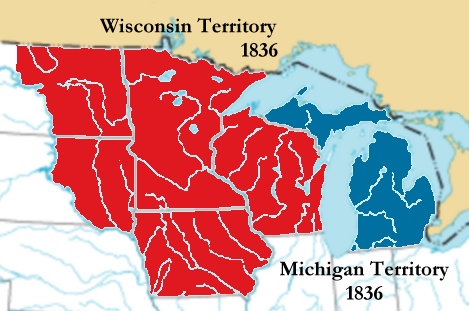
(About) The combined red and
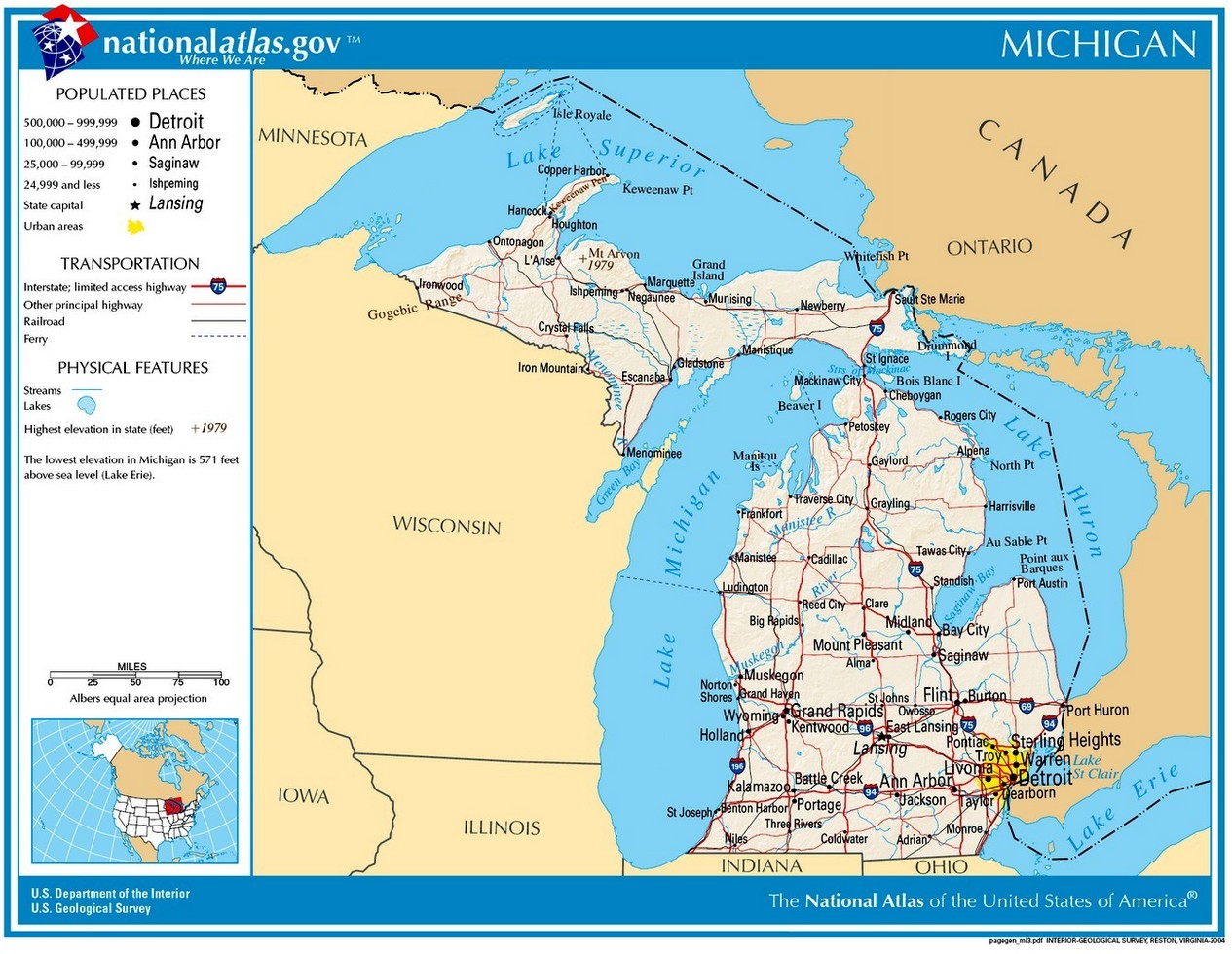
blue areas form the Michigan Territory at its maximum extent. Michigan is a state located in
the Great Lakes region of the Midwestern United States. The name Michigan is the French form of the Ojibwa word mishigamaa,
meaning "large water" or "large lake". Initially, in 1787, present-day Michigan composed a fraction of the Northwest Territory,
then it was part of the Indiana Territory in 1800, and it was declared as Michigan Territory in 1805. The Territory of Michigan
was an organized incorporated territory of the United States that existed from June 30, 1805, until January 26, 1837, when
the final extent of the territory was admitted to the Union as the State of Michigan. Michigan is the only state
to consist of two peninsulas. The Lower Peninsula, to which the name Michigan was originally applied, is often noted to be
shaped like a mitten. The Upper Peninsula (often referred to as "the U.P.") is separated from the Lower Peninsula by the Straits
of Mackinac, a five-mile channel that joins Lake Huron to Lake Michigan. The two peninsulas are connected by the Mackinac
Bridge. While sparsely populated, the Upper Peninsula is economically important due to its status as a tourist destination
as well as its abundance of natural resources. Thousands of years before
the arrival of the first Europeans, eight indigenous tribes lived in what is today the state of Michigan. They included the
Ojibwa, Menominee, Chippawa, Miami, Ottawa, and Potawatomi, who were part of the Algonquian family of Amerindians, as well
as the Wyandot, who were from the Iroquoian family and lived in the area of present-day Detroit. It is estimated that the
native population at the time the first European arrived was 15,000. The first white explorer
to visit Michigan was the Frenchman Étienne Brûlé in 1620, who began his expedition from Quebec City on the orders of Samuel
de Champlain and traveled as far as the Upper Peninsula. Afterward, the area became part of Louisiana, one of the large colonial
provinces of New France. The first permanent European settlement in Michigan was founded in 1668 at Sault Ste. Marie by Jacques
Marquette, a French missionary. The French built several
trading posts, forts, and villages in Michigan during the late 17th century. The most important was Fort Pontchartrain du
Détroit, established by Antoine de Lamothe Cadillac, which is present-day Detroit. During this time, French activities in
the region were limited to hunting, trapping, sparse agriculture, and trading with local Indians. By 1760, the Michigan countryside
had only a few hundred white inhabitants. During the American Revolutionary
War, the local European population, who were primarily American colonists that supported independence, rebelled against Britain.
The British, in 1776, with the assistance of local tribes, continually attacked American settlements and even conquered Detroit.
In 1781, Spanish raiders led by a French Captain Eugene Poure traveled by river and overland from St Louis, liberated British-held
Fort St Joseph, and relinquished authority of the settlement to the Americans the following day. The war ended with the signing
of the Treaty of Paris in 1783. Michigan was now controlled by the newly formed United States of America. In 1787, the region
became part of the Northwest Territory. The British, however, continued to occupy Detroit and other fortifications and did
not definitively leave the area until after the implementation of the Jay Treaty in 1796. The land which is now Michigan
was initially part of Indiana Territory in 1800. A portion of that area was declared as Michigan Territory in 1805, including
all of the Lower Peninsula. During the War of 1812, British forces from Canada quickly captured Detroit and Fort Mackinac,
giving them a strategic advantage and encouraging native revolt against the United States. American troops retook Detroit
in 1813 and Fort Mackinac was returned to the Americans at the end of the war in 1815. After their defeat in the
War of 1812, the tribes were forced to sell all of their land claims to the U.S. government by the Treaty of Saginaw and the
Treaty of Chicago. After the war, the government built forts in some of the Northwest Territory, such as at Sault Ste. Marie.
In the 1820s, the U.S. government assigned Indian agents to work with the tribes, including arranging land cessions and relocation.
They forced most of the Native Americans to relocate from Michigan to Indian reservations further west.
Rising settlement prompted
the elevation of Michigan Territory to that of the present-day state. In 1835, the federal government enacted a law that would
have created a State of Michigan. A territorial dispute with Ohio over the Toledo Strip, a stretch of land including the city
of Toledo, delayed the final accession of statehood. The disputed zone became part of Ohio by the order of a revised bill
passed by the U.S. Congress and signed into law by President Andrew Jackson which also gave compensation to Michigan in the
form of control of the Upper Peninsula. On January 26, 1837, Michigan became the 26th state of the Union. During the early 1840s, large
deposits of copper and iron ores were discovered on the Upper Peninsula, with Michigan the leading U.S. source by the end
of the century. The influx of Cornish miners to the area left a lasting cultural impact. Michigan actively participated
in the American Civil War (1861-1865) sending thousands of volunteers, and several Union generals hailed from the state, including
George Armstrong Custer. After the war, the local economy became more varied and began to prosper. During the 1870s, the lumber
industry, dairy farming and diversified industry grew rapidly in the state. The population doubled between 1870 and 1890. Slavery An estimated 12 million
Africans were forced across the Atlantic Ocean between 1450 and 1808, the year the United States outlawed "importing slaves"
from Africa. The men who drafted the United States Constitution debated about slavery and the legal status of enslaved people.
The Constitution they wrote viewed enslaved people as property. But there were people—enslaved and free Africans, African
Americans and European Americans—who challenged the idea that anyone could be considered property. They sought either
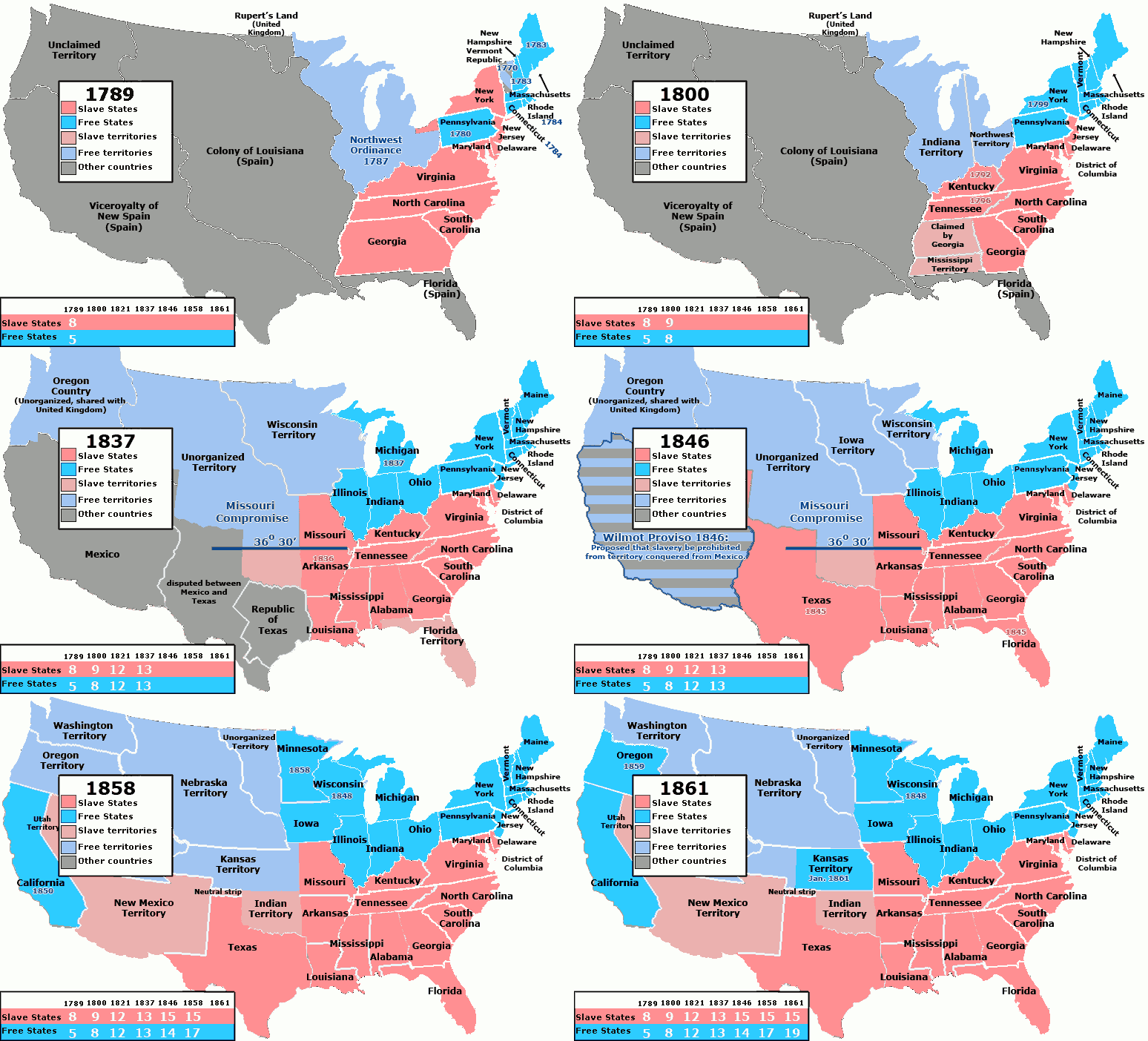
to keep slavery from growing or to end it entirely. Slavery was legal in the territory
that would become Michigan until the adoption of the Northwest Ordinance in 1787. Michigan prohibited slavery when it adopted
its first state constitution in 1835. The people who resisted slavery by escaping to Michigan, or assisted those people who
had escaped, shaped communities and lives in a state that would soon send thousands of its citizens into the bloodiest conflict
in American history, in part, to determine whether or not any person could be considered property, a slave.
Those escaping slavery
often used political and religious networks of African and European men and women, rather than specific routes. They traveled
through places like Ohio, Indiana and Illinois on their way to Michigan. Most traveled by foot and/or wagons. Some made direct
journeys from the South, while others spent short or longer times in communities along the way. Antislavery activists used
many strategies, including public demonstration, challenging and changing the laws, forming antislavery organizations or religious
congregations, holding public meetings, and speaking and writing against slavery. Through religious and/or political affiliations,
European American and legally free and formerly enslaved African American women and men in Michigan often knew each other.
They provided safe places for African Americans who escaped slavery, food and sometimes clothing. They helped create opportunities
for the formerly enslaved to start new lives in Michigan in tolerant communities. Michigan has many Civil
War heroines. Among them were Quakers who worked in the Underground Railroad. Born a Quaker, Laura Smith Haviland lived in
Adrian and led escaped slaves to freedom in Canada. She was so effective in her abolitionist activities and her work for the
Underground Railroad that Southern slave owners offered a $3,000 reward for her capture. She and her family opened one of
the first schools in Michigan to admit black boys and girls. A historical marker stands at the Raisin Valley Friends Church
in Adrian where her father was the first pastor. Laura Haviland is buried in the church cemetery. Another Michigan Civil
War heroine was Sojourner Truth. Born a slave in New York in 1797, she was freed in 1828 and became an advocate for abolition
(making slavery illegal) and for woman suffrage (giving women the right to vote). In 1856, she moved to Battle Creek. She
traveled throughout the nation preaching about emancipation and the rights of black people and women. While black and white communities
did not always live side-by side, they sometimes joined together to resist attempts of "slave owners" to take formerly enslaved
women and men back into slavery. In several cases, they provided defense and protection against the men and women who claimed
ownership over African Americans who had escaped to Michigan. Their tactics included confrontation, legal battles, writing
and speaking about slavery and the need to end it.
Civil War According to the 1860 U.S.
census, Michigan had a population of 749,113. Although Michigan did not fight any battles
on its soil, its soldiers fought in practically every major battle and campaign during the American Civil War. Michigan made a substantial contribution
to the Union during the Civil War. While far removed from the fighting in the war, Michigan supplied a large number of troops
and several generals, including George Armstrong Custer. When, at the beginning of the war, Michigan was asked to supply no
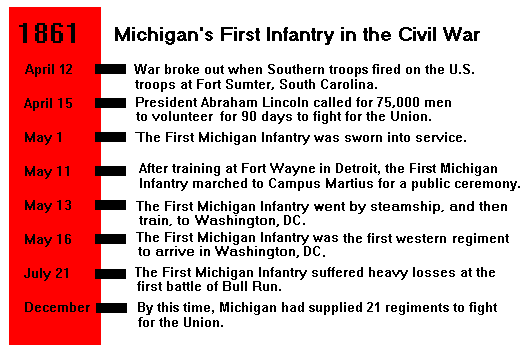
more than four regiments, Governor Austin Blair (January 2, 1861 - January 5, 1865) sent seven. Upon the arrival
of Michigan's 1st volunteers in Washington D.C. (known as Washington City at the time), May 16, 1861, they were the first
to arrive from a western state, prompting President Lincoln to remark, "Thank God for Michigan!" Colonel Willcox (later promoted
to brevet major-general) soon led the 1st Michigan Volunteers at the First Battle of Bull Run (aka Manassas), Virginia,
on July 21, 1861. During the conflict's initial major engagement, WIllcox, while leading the 1st Michigan, was
wounded and captured during the repeated charges against the enemy's position. Because of Willcox's action at Bull Run, he
was awarded the Medal of Honor (in 1895), with the following citation: At Bull Run, Va., 21 July 1861, "led repeated charges
until wounded and taken prisoner." More than 90,000 Michigan men,
nearly a quarter of the state's male population in 1860, served in the war. In addition to the approximately 600 men who joined
the Union Navy, Michigan raised 36 regiments and 7 companies infantry volunteers (including 1 regiment of Colored troops),
1 regiment of sharpshooters, 12 regiments and 2 companies of cavalry, 1 heavy artillery regiment, 14 light artillery
batteries, 1 engineer regiment, and numerous small independent units. During the war, 4,007 officers were commissioned; 2,067
left the state with regiments; 1,940 were promoted from the ranks, except 10, who were appointed from the regular army, and
a small number were commissioned to recruit within the state. Among the more celebrated units was the 24th Michigan Volunteer Infantry, which, as a part of the famed Iron Brigade, suffered considerable losses at the Battle of Gettysburg while
defending McPherson's Ridge. George Armstrong Custer's "Michigan Wolverine" Cavalry effectively battled J.E.B. Stuart at Gettysburg
on the East Cavalry Field. The 4th Michigan Cavalry, however, was ordered to capture Confederate President Jefferson Davis in May of 1865.
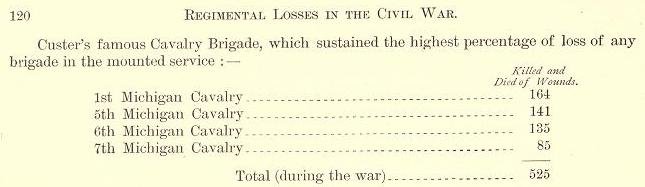
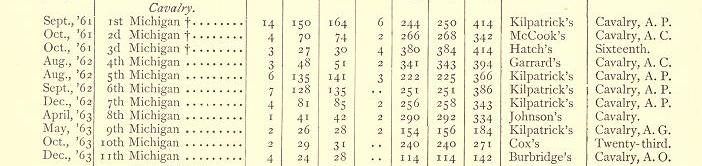
(Right) Fox, William F. Regimental Losses in the American Civil
War (1889). Fox, highly acclaimed Civil War statistician and most quoted source for the conflict's statistics, is often cited
by historians and authors for his work on the "300 Fighting Regiments." While units etched in the pages
of the Fighting 300 was a tribute to the heroic men on the 300 regimental rolls, Fox reserved another list that included
only eleven brigades. Although Fox listed eleven "famous brigades" during the Civil War, ten belonged to infantry
and only one was of cavalry. The Michigan Cavalry Brigade, aka Custer's Brigade, was the most famous cavalry brigade of the
Civil War. Fox, not being remiss of other cavalry brigades, had indicated a common theme in the selection of famous brigades: the
brigade had to have fought in several major battles; had to have been pivotal in the outcome of at least one
major battle; and each of the eleven brigades on the list suffered monumental casualties. Custer's Cavalry Brigade,
which fought in every major battle in the Army of the Potomac, suffered the highest casualties of any Union cavalry
brigade during the Civil War. A household name because of "Custer's Last Stand," George Armstrong Custer, who graduated
last in the encore West Point class of 1861, was an academic failure by most standards, but he was an indisputable
genius on the battlefield. Only when Civil War commenced in 1861, was the potential of the young 22 year old Michigander
realized. What Custer had lacked with pen and paper in the classroom setting, he compensated for
it with prowess and mastery of cavalry tactics in battle. At age 23, Custer, one of the youngest generals in the
Union military, among his many exploits, had checked the Confederate's finest cavalry units, led by JEB Stuart, during
the Gettysburg Campaign. Custer, known for his recurrent antics at West Point, was now well-known for
unleashing punitive cavalry strikes against Confederate forces during his four year combat classroom. Recognized
also for his brashness and overtures of rhetoric, the now mature Custer, reinforcing said reputation, never
disappointed on the field of battle. When pen met paper at the cessation of hostilities, this time, when it was
most noteworthy, it was Custer who graduated first in his Civil War cavalry class of 1865. Custer's Cavalry Brigade
had lost more men in killed and mortally wounded than any other Union cavalry brigade. Reason for the high casualties was
elementary: Custer fought, and he fought often. The totals listed from Fox on this page appear to be misleading,
because the numbers include only those cavalrymen who were killed or mortally wounded. Absent were those who died as prisoners
of war, died by disease, and died from causes other than battle. The wounded were also not tabulated. Nevertheless,
total casualties, including dead and wounded, for Custer's Brigade exceeded 2,000: 1,509 total fatalities (all causes) and
more than 500 wounded. See also Civil
War Cavalry and Mounted Forces. The Union Army (1908) was vague in its totals for Custer's Brigade, but Dyer was
concise, and so was Fox in chapter XII, Regimental Losses.
(Above) Fox, p. 510, chapt. XII,
Regimental Losses in the American Civil War (1889), indicates the total casualties by category for each regiment, 1st,
5th, 6th, and 7th, that formed Custer's Brigade. Categories indicate killed, mortally wounded, died of disease,
died as prisoners of war, died of accidents, and died from all causes other than battle. Wounded, on the other hand, was
defined as unfit for battle or combat. Soldiers who were slightly wounded but continued to engage in battle, however, were
not counted as wounded; although some of the soldiers were missing fingers and even toes. When
the totals are referenced with Dyer's numbers, they concur. Although the Union Army, 1908, was vague and offered no specifics,
just a single total for killed in each regiment, the collective totals, nevertheless, still closely resemble those from
Fox and Dyer who specified 1,509 in total killed and more than 500 as seriously wounded. Grand total was more than 2,000 casualties.
Wounded numbers, added to the following totals (excluding the 7th Michigan that was not listed by Fox among the 300), are
derived from Fox, chapt. X, Three Hundred Fighting Regiments:
1st Michigan Cavalry: killed, mortally wounded, died of disease, died while prisoner
of war, died from all causes other than battle. Total 414. Casualties, including killed, mortally wounded, all deaths other
than battle, and wounded (not mortally). Grand Total 584. Prior to Confederate forces firing on Fort Sumter, Michigan Governor Austin Blair
had already committed Michigan's support to the Union cause. Blair, an ardent abolitionist
and supporter of the Union, pledged his state's commitment in his first inaugural address in January of 1861: "Secession
is revolution, and revolution in the overt act is treason and must be treated as such. It is a question of war that the seceding
states have to look in the face. They who think that this powerful government can be disrupted peacefully have read history
to no purpose. The sons of the men who carried arms in the seven years war with the most powerful nation in the world, to
establish this government, will not hesitate to make equal sacrifices to maintain it." See also Michigan and the American Civil War (1861-1865). No
definite action was taken until word was received of the firing on Sumter, followed by the first call for troops. The news
was as a trumpet call "to arms." Gov. Blair issued a proclamation April 16, calling for ten companies of volunteers, and proceeded
to Detroit to attend a meeting held there that afternoon. Michigan's quota was one regiment of infantry, to be fully clothed,
armed and equipped, and it was estimated that $100,000 would be necessary for this purpose. The treasury was comparatively
empty and the state was in no condition to meet the requirements promptly. This being made known, a resolution was passed
at the Detroit meeting, pledging the city to a loan of $50,000 to the state, and calling upon the state for a like amount.
Those present pledged $23,000, and in a very short time $81,020 had been subscribed. This enabled the state treasurer, "Hon.
John Owen, to negotiate a loan, chiefly from the state's own citizens, sufficient for the needs of the hour, and this, together
with all subsequent indebtedness of a like nature, was assumed by the state."
Enlistments dragged after the
disastrous Peninsular Campaign (March - July 1862), and to stimulate the patriotism of the people public meetings were held.
One of these, held in Detroit July 15, 1862, was disrupted by a mob, whose members drove every speaker and officer from the
stand, pursuing them into the Russell House and other places near by. "This exhibition of treason aroused the lethargic spirit
of the people" and a week later an immense gathering was held, at which pledges of patriotism, means and persistent support
were given, and measures taken for recruiting the regiments. Resolutions were adopted, favoring the raising of means, both
by the city government and by citizens; treason was roundly denounced; enthusiastic addresses were made and loudly applauded
by thousands of all conditions and walks of life — acres of ground being crowded by patriotic people. Bounties of from
$10 to $30 were offered by individuals for enlistments in their respective wards; one laboring man offered $50 towards raising
half a company in his ward; another offered $1 each to every man who enlisted from the city of Detroit. The report of the adjutant-general at the close of
1862 indicated a total enrollment of 45,569 troops since the beginning of the war. This did not include fully 1,400, known
to have gone into regiments of other states, nor several hundred who had gone into the regular army. The total number drafted during the fall and winter
of 1863 was 6,383. Of these, 261 were sent to the rendezvous at Grand Rapids, 643 furnished substitutes (of whom 43 deserted),
1,626 paid $300 commutation money, 596 were exempted for physical disability, 330 as aliens, 204 for unsuitableness of age,
and 1,069 failed to report. At the end of the year 1863 an aggregate of 53,749 had been mustered in. The offer of the government
to accept reenlistment of soldiers with the title of "veteran" was accepted by 5,545 men. By
Oct. 1864, this gave the state a total credit of 83,347 from the beginning of the war. In 1864, the state was targeted by Southern sympathizers
who had fled to Canada, that place being a convenient rendezvous. The Confederate government sent paid emissaries there for
the purpose of fomenting trouble. Being on the border, Michigan was continually threatened and found it necessary to be constantly
on guard against probable invasions. Several companies were kept on duty in and about Detroit to guard the city from pillage
and the torch, armed steam tugs were continually occupied in patrolling the river, and a small force guarded the arsenal at
Dearborn, where were stored 35,000 stands of arms. A party of 4 men, led by Bennett G. Burley, boarded
the passenger steamer Philo Parsons at Detroit, for Sandusky, Sept. 19, 1864, and were joined at Sandwich and Amherstburg,
Canada, by 30 more. This party seized the boat shortly before reaching Sandusky and the steamer Island Queen at Middle Bass
island, and announced their intention of capturing the U.S. war vessel Michigan, which was guarding Johnson's island, on which
were 3,000 Confederate prisoners. The Island Queen was finally cast adrift. In the party was a Capt. Beall, who appeared to
be in command and who subsequently stated he was a Confederate officer. The Parsons was afterwards steered towards Detroit,
some of the passengers being put ashore on American soil. The steamer was afterwards found at Sandwich. It also transpired
that Burley was commissioned an acting master in the Confederate navy, and that an effort to get possession of the Michigan
and liberate the prisoners had been authorized by President Davis. "Burley was extradited and tried in Ohio, the jury failing
to agree as to the nature of the crime. Being recommitted, he broke jail and fled the country, returning to Scotland, his
native land."
The success of the Union army
during the fall of 1864 and the winter and spring of 1865 brought the war to a close and orders were at once issued to cease
recruiting and drafting. The adjutant-general's department showed that Michigan had enlisted and drafted 90,747 men, though
the provost marshal-general gave credit for only 90,048. Of these, 1,661 were colored, 145 were Indians, and 14,393 were foreign-born,
"representing nearly all countries of Northern Europe, France and French dominions, Spain and Spanish-America. The amount
paid by drafted citizens of Michigan as commutation money was $594,600." 14,753 Michigan soldiers died
in service (including 623 at Andersonville Prison in Georgia). 4,448 of these deaths were combat deaths while the majority,
more than 9000, were from disease, a constant fear in crowded army camps with poor food, sanitation and exposure issues and
pre-modern medicine. This put Michigan's loss at sixth highest among the Union states (the non-state U.S. Colored Troops losses
also exceeded Michigan's). In 1865, Governor Austin Blair, in
one of his final gestures as acting governor, established the Michigan Soldiers' and Sailors' Monument Association
in order to collect funds for a monument commemorating Michigan's sailors and soldiers killed during the Civil War. Voluntary
subscriptions from citizens were collected and sculptor Randolph Rogers, who had created similar Civil War commemorative monuments
in Ohio and Rhode Island, was chosen as the artist for the monument. The state's foremost Civil War monument was unveiled
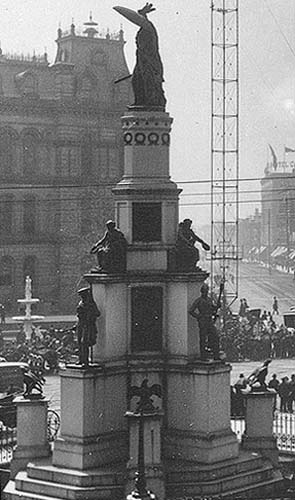
on April 9, 1872. Attending the dedication were Generals George Armstrong Custer, Philip H. Sheridan and Ambrose E. Burnside. (Right) Michigan Soldiers' and
Sailors' Monument in 1888 with the old Detroit City Hall in the background. Photograph courtesy National Park Service
and Manning Brothers Commercial Photographers, Detroit, MI. Early in June, 1865, arrangements
were made for the reception of the returning troops and as they entered the state they were taken in hand and substantially
entertained. The use of the upper story of a large freight house at Detroit was donated by the Michigan Central railroad and
fitted up as a dining room with a seating capacity of 2,000. From that time until June 10, 1866, 19,510 Michigan and 3,506
Wisconsin troops were cared for at that place. Similar arrangements had been made at Jackson and in the same period of time
10,659 soldiers received the cordial, substantial reception accorded those who rendezvoused at Detroit. Gov. Henry Crapo (January 3,
1865 - January 6, 1869), who succeeded Blair, issued a proclamation on June 14, 1865, welcoming and thanking the returning
Michigan troops. In conclusion he said: "We are proud in believing that
when the history of this rebellion shall have been written, where all have done so well, none will stand higher on the roll
of fame than the officers and soldiers sent to the field from the loyal and patriotic state of Michigan." Care of the Wounded and Sick Michigan's part in the care of
suffering soldiers was a creditable one. Her surgeons were ready at all times to meet the exigencies of the times and many
of her own soldiers, as well as those of other states, owed their lives to the promptness and solicitude shown by her medical
men and the agents appointed by the governor. The legislature of 1863 appropriated $20,000 for the work, and in 1865 an additional
sum of $25,000. Gen. Joseph K. Barnes was appointed surgeon-general, and his selection proved to be a happy one. After the
battle of Gettysburg, the surgeons, with their assistants, left for the scene, with a quantity of sanitary stores, prepared
in large part by the women of the state. No distinction was made in treating the wounded, the wounded Confederate also receiving
careful attention. After the engagement at Perryville in 1862, several thousand sick and wounded Confederates were in the
hospitals at Harrodsburg, Ky. Surgeon William H. DeCamp of the Mich, engineers and mechanics was detailed as medical director,
in charge of all the hospitals at that point, and his attitude was such as to elicit the voluntary written thanks of
the surgeons of the Confederacy in attendance. The Michigan Soldiers'
Relief Association of Washington, D.C, is said to have been the first to commence its work in the field at the east and the
last to cease, beginning as it did in the autumn of 1861 and continuing until Sept., 1866. This association was formed by
Michigan people at the capital, with Hon. James M. Edmunds president, Dr. H. J. Alvord, secretary, and Z. Moses, treasurer.
Membership assessments were necessary at first, but as soon as its organization and aims became known to the people of the
state, contributions began to pour in until they had aggregated $24,902.24. In the trying period of Grant's great battles,
when sickness and wounds were the greatest, the association established the famous Michigan soup house at City Point, which
relieved the suffering of thousands, regardless of state. It followed closely in the wake of the Army of the Potomac in its
Peninsular Campaign, found plenty to command its attention after the second Bull Run and the various engagements which filled
the hospitals at Washington, Baltimore and Fortress Monroe, and later at Alexandria, Frederick City, Annapolis, New York and
Philadelphia In 1863, after the campaign in Maryland and Pennsylvania, including bloody Gettysburg, and in 1864, following
the battles of the Wilderness and Spotsylvania, and the operations about Richmond and Petersburg, the hospitals were filled.
The necessities were great, but the association met them with the aid of the Christian and U.S. sanitary commissions. In the
later days of the war a home was established in Washington, where the wounded and sick, passing through the city, were given
shelter. For many days the bread consumed averaged over 300 loaves daily, and imperfect records showed over 8,000 names of
those furnished one or more meals. At the conclusion of the active campaign of Sherman's
army, Michigan regiments, quartered at and near Washington, were supplied with vegetables, pickles, bread and tobacco. See
also Michigan and the American Civil War (1861-1865).
Aftermath After
the conflict, Lansing, the capital, was so designed as to give a special military museum, and in a large, commodious
room may be found Michigan's battleflags, in regimental order, in vertical cases of novel construction in the center of the
apartment, reaching almost to the ceiling and of heavy plate glass. Other cases ranged about the walls contain many interesting
relics, including Confederate flags captured by the regiments. A Roll of Honor was prepared under a resolution of the state
legislature in 1869. It was completed in 1872 and contains the names of all citizens of Michigan who had fallen in battle,
or died in consequence of wounds received during the war, or who had died in southern prisons or hospitals. The roll shows
14,855 names, engrossed on English parchment and required two years time on the part of John Radiger. It is in two volumes,
bound in Russia leather, with ornamental brass trimmings and fastenings. Michigan's timber and mining
industries were expanded under the control of large Eastern corporations and their output rose dramatically during Reconstruction. After the war, the local
economy became more varied and began to prosper. The Upper Peninsula proved to be a rich source of lumber, iron, and copper.
Michigan led the nation in lumber production from the 1850s to the 1880s. Railroads became a major engine of growth from the
1850s onward, with Detroit the chief hub. During the 1870s, the lumber industry, dairy farming and diversified industry grew
rapidly in the state. Michigan's population, consequently, doubled between 1870 and 1890.
|
|
|
||||||||||||||||||||||||||||||||||||||||||||||
|
||||||||||||||||||||||||||||||||||||||||||||||||||
|
|
|
|
|
|
|
|
|
|
|
|
|
|
|
|
|
||||||||||||||||||||||||||||||||||
|
|
|
|
|
|
|
|
|
|
|
|
|
|
|
|
|
||||||||||||||||||||||||||||||||||
|
|
|
|
|
|
|
|
|
|
|
|
|
|
|
|
|
||||||||||||||||||||||||||||||||||
|
|
|
|
|
|
|
|
|
|
|
|
|
|
|
|
|
||||||||||||||||||||||||||||||||||
|
|
|
|
|
|
|
|
|
|
|
|
|
|
|
|
|
||||||||||||||||||||||||||||||||||
|
||||||||||||||||||||||||||||||||||||||||||||||||||
|
|
Sources: National Park
Service; Library of Congress; National Archives; Official Records of the Union and Confederate Armies; US Census Bureau; The
Union Army (1908); Fox, William F. Regimental Losses in the American Civil War (1889); Phisterer, Frederick. Statistical record
of the armies of the United States (1883); Dyer, Frederick
H. A Compendium of the War of the Rebellion (1908); Hardesty, Jesse. Killed and died of wounds in the Union army during the
Civil War (1915) Wright-Eley Co.; Bratt,
Peter. "A Great Revolution in Feeling: The American Civil War in Niles and Grand Rapids, Michigan," Michigan Historical Review
vol. 31#2 (2005); Hershock, Martin J. "Copperheads and Radicals: Michigan Partisan
Politics during the Civil War Era, 1860-1865," Michigan Historical Review 18 (Spring 1992); Michigan, State of. Michigan Manual
(annual); Michigan Historical Review Central Michigan University (quarterly);
Michigan Department of Natural Resources; Nolan, Alan T. The Iron Brigade: A
Military History (1994); Press, Charles et al., Michigan Political Atlas (1984);
Public Sector Consultants. Michigan in Brief. An Issues Handbook (annual); Rich, Wilbur. Coleman Young and Detroit Politics: From Social Activist to Power Broker
(Wayne State University Press, 1988); Rubenstein, Bruce A. and Lawrence E. Ziewacz. Michigan: A History of the Great Lakes
State. (2002); Sisson, Richard, Ed. The American Midwest: An Interpretive Encyclopedia (2006); Larry J. Wagenaar and Izzi
Bendall. Michigan History Directory of Historical Societies, Museums, Archives, Historic Sites, Agencies and Commissions (13th
Ed. 2011); Weeks, George, Stewards of the State: The Governors of Michigan (Historical Society of Michigan, 1987).
Return to American Civil War Homepage
|
|
|
||||||||||||||||||||||||||||||||||||||||||||||
|
||||||||||||||||||||||||||||||||||||||||||||||||||