Minnesota Civil War History
|
|
|
|
|
|
|
|
Minnesota Civil War History |
|
||
|
|
|
|
||
|
|
|
|
|
|
|
|||||
|
|
||||
|
|||||
|
||||||||||||||||||||||||||||||||||||||||
|
|
Introduction Minnesota is a U.S. state located
in the Midwestern United States. Minnesota was carved out of the eastern half of the Minnesota Territory and admitted to the
Union as the 32nd state on May 11, 1858. A portion of present-day Minnesota was originally part of the Louisiana Purchase in 1803. The
history of Minnesota is shaped by its original Native American residents, European exploration and settlement, and
the emergence of industries made possible by the state's natural resources. Minnesota achieved prominence through fur trading,
logging, and farming, and later through railroads, and iron mining. The earliest known settlers followed
herds of large game to the region during the last glacial period. They preceded the Anishinaabe, the Dakota, and other Native
American inhabitants. Fur traders from France arrived during the 17th century. Late that century, Anishinaabe, also known
as Ojibwe Indians, migrated westward to Minnesota, causing tensions with the Dakota people. Numerous explorers such as Daniel
Greysolon, Sieur du Lhut, Father Louis Hennepin, Jonathan Carver, Henry Schoolcraft, and Joseph Nicollet, among others, mapped
out the state. Europeans, moving west during the 19th century, drove out most of the Native Americans. Fort Snelling, built
to protect United States territorial interests, brought early settlers to the area and they used Saint Anthony Falls for powering
sawmills in the area that became Minneapolis, while others settled downriver in the area that became Saint Paul. The portion of the state east
of the Mississippi River became part of the United States at the end of the American Revolutionary War, when the Second Treaty
of Paris was signed. Land west of the Mississippi River was acquired with the Louisiana Purchase, although a portion of the
Red River Valley was disputed until the Treaty of 1818. In 1805, Zebulon Pike bargained with Native Americans to acquire land
at the confluence of the Minnesota and Mississippi rivers. The construction of Fort Snelling followed between 1819 and 1825.
Its soldiers built a grist mill and a sawmill at Saint Anthony Falls, the first of the water-powered industries around which
the city of Minneapolis later grew. Meanwhile, squatters, government officials, and tourists had settled near the fort. In
1839, the Army forced them to move downriver and they settled in the area that became St. Paul. Thousands of people had
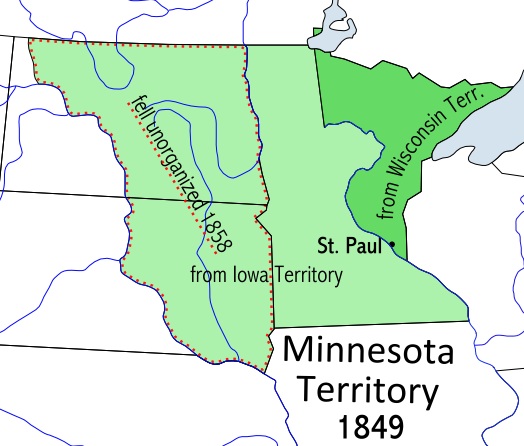
arrived to build farms and cut timber, and on March 3, 1849, the Minnesota Territory was formed. Subsequently, Minnesota became
the 32nd U.S. state on May 11, 1858. During the American Civil War (1861-1865), 22,000 Minnesotans served in the Union
Army and many fought in several major battles and campaigns in the Southern states. Slavery The Northwest Ordinance
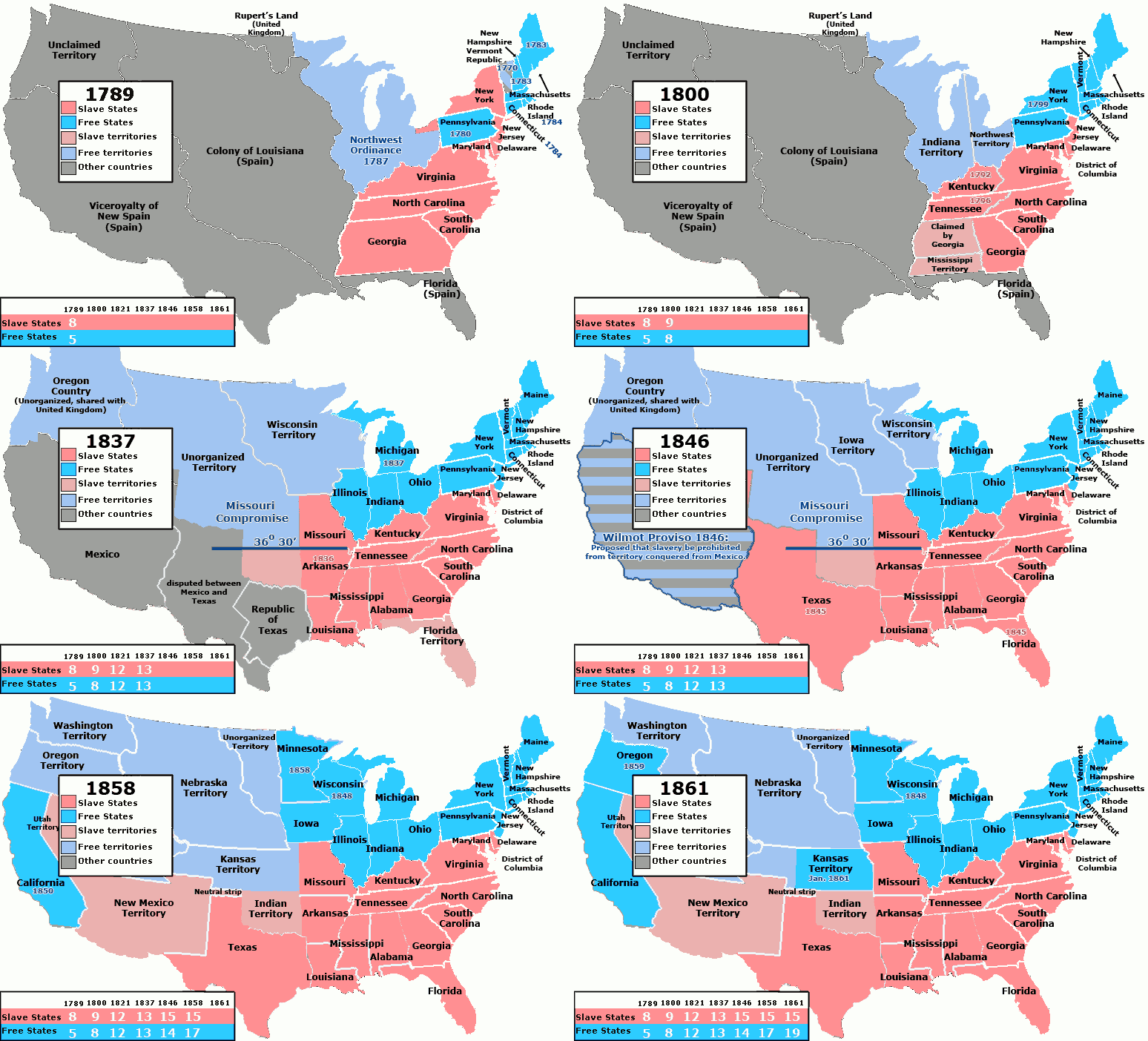
of 1787 in theory outlawed slavery in the Northwest Territory including the Minnesota area. The ordinance specifically stated: "There shall be neither
slavery nor involuntary servitude in the said territory, otherwise than in the punishment of crime, whereof the party shall
have been duly convicted." The ordinance was nevertheless
seen as ambiguous in that it did not specifically address the slaves already in the territories, and it discussed the "free"
population of the territories seemingly implying that a slave population would exist. French traders in the territories, and
afterwards American army officers (including Josiah Snelling who commanded his namesake fort), continued to hold slaves with
the blessings of many in Congress. The number of African Americans
in the territory during this period was quite small but not insignificant. New arrivals continued to bring slaves with them,
but there were many free blacks as well, some working as servants and some as completely independent pioneers. Information
about the black immigrants during the earlier periods is sparse, but records do show that most of those at Fort Snelling were
slaves. Records from 1850 indicate
a population of 39 free blacks out of a total population of 6,077 citizens in the territory (which excluded Native American
tribes). Before the 1840s these free persons could often expect to be treated equal to other racial groups. By the time Minnesota
had achieved statehood, however, blacks had been disenfranchised and schools were segregated. Nevertheless, from the start
of the Minnesota Territory in 1849 the leadership was predominantly antislavery thus ending the practice in this era. In the 1850s, Fort Snelling played
a key role in the infamous Dred Scott court case. Slaves Dred Scott and his wife were taken to the fort by their master, John Emerson. They lived at the fort and elsewhere in
territories where slavery was prohibited. After Emerson's death, the Scotts argued that since they had lived in free territory,
they were no longer slaves. Ultimately in 1857 the U.S. Supreme Court sided against the Scotts. This decision helped to fuel
rancor over slavery leading to the Bleeding Kansas conflicts, the Panic of 1857, and eventually the American Civil War.
Sentiment The Minnesota Territory
(March 3, 1849-May 11, 1858) was established from the lands remaining from Iowa Territory and Wisconsin Territory on
March 3, 1849. The Minnesota Territory extended far into what is now North Dakota and South Dakota, to the Missouri River.
There was a dispute over the shape of the state to be carved out of Minnesota Territory. An alternate proposal that was only
narrowly defeated would have made the 46th parallel the state's northern border and the Missouri River its western border,
thus giving up the whole northern half of the state in exchange for the eastern half of what later became South Dakota. With Alexander Ramsey (Whig)
as the first governor of Minnesota Territory (June 1, 1849--May 15, 1853) and Henry Hastings Sibley (Democrat) as the territorial
delegate to the United States Congress (later first Governor of the State of Minnesota), the populations of Saint Paul and
Saint Anthony swelled. Henry M. Rice (D), who replaced Sibley as the territorial delegate in 1853, worked in Congress to promote
Minnesota interests. He lobbied for the construction of a railroad connecting Saint Paul and Lake Superior, with a link from
Saint Paul to the Illinois Central. In December 1856, Rice
introduced two bills in Congress: an enabling act that would allow Minnesota to form a state constitution, and a railroad
land grant bill. Rice's enabling act defined a state containing both prairie and forest lands. The state was bounded on the
south by Iowa, on the east by Wisconsin, on the north by Canada, and on the west by the Red River of the North and the Bois
de Sioux River, Lake Traverse, Big Stone Lake, and then a line extending due south to the Iowa border. Rice made this motion
based on Minnesota's population growth. At the time, tensions between
the Northern and the Southern United States were growing, in a series of conflicts that eventually resulted in the Civil War.
There was little debate in the United States House of Representatives, but when Stephen A. Douglas introduced the bill in
the United States Senate, it caused a firestorm of debate. Northerners saw their chance to add two senators to the side of
the free states, while Southerners were sure that they would lose power. Many senators offered polite arguments that the population
was too sparse and that statehood was premature. Senator John Burton Thompson of Kentucky, in particular, argued that new
states would cost the government too much for roads, canals, forts, and lighthouses. Although Thompson and 21 other senators
voted against statehood, the enabling act was passed on February 26, 1857. After the enabling act was passed,
territorial legislators had a difficult time writing a state constitution. A constitutional convention was assembled in July
1857, but Republicans and Democrats were deeply divided. In fact, they formed two separate constitutional conventions and
drafted two separate constitutions. Eventually, the two groups formed a conference committee and worked out a common constitution.
The divisions continued, though, because Republicans refused to sign a document that had Democratic signatures on it, and
vice versa. One copy of the constitution was written on white paper and signed only by Republicans, while the other copy was
written on blue-tinged paper and signed by Democrats. These copies were signed on August 29, 1857. An election was called
on October 13, 1857, where Minnesota residents would vote to approve or disapprove the constitution. The constitution was
approved by 30,055 voters, while 571 rejected it. The state constitution was sent
to the United States Congress for ratification in December 1857. The approval process was delayed for several months while
Congress debated over issues that had stemmed from the Kansas-Nebraska Act. Southerners had been arguing that the next state should be pro-slavery, so
when Kansas submitted the pro-slavery Lecompton Constitution, the Minnesota statehood bill was delayed. After that, Northerners
feared that Minnesota's Democratic delegation would support slavery in Kansas. Finally, after the Kansas question was settled
and after Congress decided how many representatives Minnesota would get in the House of Representatives, the bill passed.
The eastern half of the Minnesota Territory, under the boundaries defined by Henry Mower Rice, became the country's 32nd state
on May 11, 1858. The western part remained unorganized until its incorporation into the Dakota Territory on March 2, 1861.
Civil War According to the 1860 U.S. census,
Minnesota had a population of 172,023. Minnesota strongly supported
the war effort, and at least 22,000 Minnesotans served in the Union Army. According to The Union Army (1908), "Minnesota's
offering to the Union was 26,717, including citizen soldiery during the Indian war, and after deducting reenlistments
her contribution compared favorably with the number furnished by any state in the Union, being 22,970 net." Minnesotans were
organized into 11 regiments of infantry, 2 regiments and 10 companies of cavalry, 1 heavy regiment (12 companies) and
3 light batteries of artillery, and numerous independent and unattached units. As a result of the Civil War, the state suffered
2,584 in killed and hundreds more in wounded. Minnesotans fought two Civil
Wars. While the state did not fight any Civil War battles on its soil, Minnesotans
fought in several major battles and campaigns in the Southern states. The state also faced another crisis as the Dakota
War of 1862 (also known as the Sioux Uprising or Little Crow’s War) commenced. Many of the regiments fought exclusively
against the Confederate Army in both the East and South, while some of the state's units fought from Civil War battles
to suppressing the Sioux Uprising and Indian battles in Minnesota, the Dakotas and beyond. Minnesota was the first state
to offer volunteers and it was one of the last to have volunteer units still on duty more than a year after the war ended. Minnesotans
fought in most of the war’s campaigns and major battles, especially in the Western Theater where most of its units
served. Only sixteen months into the conflict the Minnesota frontier exploded into a second front. In little more
than a month more civilians were killed than all of the state’s Civil War combat deaths. For the next three years
Minnesota soldiers learned their trade garrisoning forts and outposts or enduring arduous punitive expeditions into the Dakotas.
Most were eventually deployed south after repeated Federal demands. Those who came home had experienced a much more diverse
army life than other Civil War veterans.
Minnesota provided eleven infantry
regiments and one smaller battalion for Federal service. The First Minnesota Regiment earned immortality with the Army
of the Potomac, while Minnesota Regiments serving in the west earned high reputations. The Second Minnesota Regiment fought
heroically at the battles of Mill Springs, Chickamauga and Missionary Ridge. The Fourth captured flags at Allatoona and
fought at the Battle of Nashville. Heroic rear-guard action at Brice’s Crossroads sent over 250 of the Ninth Regiment
to Andersonville Prison. Minnesotans typically garrisoned frontier posts before being ordered south. Only the First Regiment,
First Battalion and the First and Second Companies of Sharpshooters served their entire enlistments in the Eastern Theater.
The First Minnesota Battalion Infantry, a nine company organization, was formed in 1864 and 1865 from approximately 60 reenlisted
veterans of First Minnesota Regiment and new enlistees. The First Minnesota Volunteer
Infantry Regiment mustered for a three-year term (1861-1864) in the Union Army at the outset of the Civil War when the
prevailing enlistment period was three months. During offensive movements, it sustained high degrees of casualties at
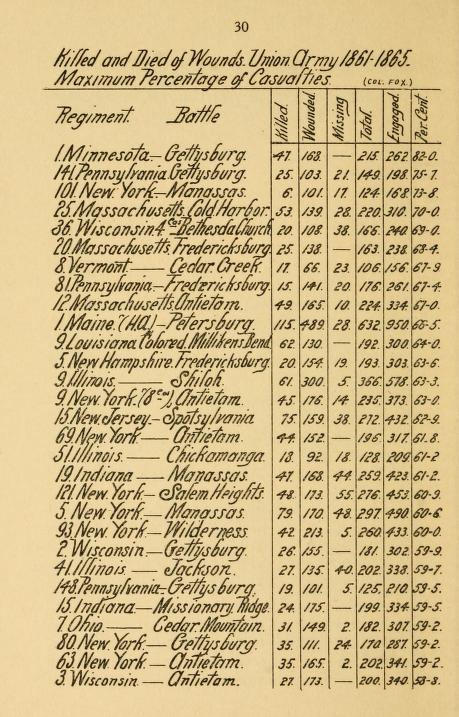
the Battles of First Bull Run (20%) and Antietam (28%) and a catastrophic degree of casualties (82%) at the Battle of Gettysburg. It is most noted for its service on the second day at Gettysburg. The
First Minnesota continued in the Army of the Potomac, serving later in 1863 in the Bristoe Campaign and the subsequent Mine
Run Campaign. It was mustered out of service upon completion of its enlistment on April 29, 1864, at Fort Snelling. Although
its ranks had been depleted during numerous battles, the majority of the regiment's veterans reenlisted to form the nucleus
of the First Minnesota Infantry Battalion which returned to Virginia and served through the end of the war. Other
veterans provided officers for the First Minnesota Heavy Artillery Regiment. Minnesota had furnished the first
"three years regiment" that reached the seat of hostilities, and, according to sources, the First Minnesota Volunteers lost
the greatest number of men at Gettysburg, in proportion to the number engaged, of any Union regiment in any single battle
fought during the war. The men of the First Minnesota are most remembered for their actions on July 2, 1863, during the
second day's fighting at Gettysburg, where the regiment prevented the Confederates from pushing the Federals off of Cemetery Ridge, a position that was to be crucial in the battle. At Gettysburg, Maj. Gen. Winfield
S. Hancock, commander of the II Corps, ordered Col. William Colvill's First Minnesota to assault a much larger enemy
force (a brigade commanded by Brig. Gen. Cadmus M. Wilcox) and to take the enemy's colors. The fateful charge bought the time
needed while other forces were brought up. During the charge, according to the unit's historian, 215* of the 262 men
who made the gallant assault became casualties, including the regimental commander, Col. William Colvill (wounded), and
all but three of his regimental Captains. The unit's flag fell five
times and rose again each time. The 47 survivors rallied back to General Hancock under the senior surviving officer, Captain
Nathan S. Messick. The 82.1 percent casualty rate
stands to this day as the largest loss by any surviving military unit in U.S. history during a single day's engagement. The unit's flag is now in the Minnesota Capitol's rotunda. As a result of the unit's actions
at Gettysburg, two soldiers from the First Minnesota were awarded the Medal of Honor. Their citations are as follows: O'BRIEN,
HENRY D. SHERMAN, MARSHALL With 262 officers and men
engaged on that fateful 2nd day at Gettysburg, this regiment, according to The Union Army (1908), "lost 50 killed and
174 wounded, a total of 224*, leaving but 38 capable of duty. Of the wounded 25 died
of their injuries, making casualties of those engaged, a percentage unequalled in military statistics, if massacres, where
all or nearly all lose their lives, be excepted." As a result of the Civil War, the First Minnesota suffered the loss of 10
officers and 177 enlisted men killed in action or who later died of their wounds, plus another 2 officers and 97 enlisted
men who died of disease, for a total of 286 fatalities, and 609 wounded. See also Minnesota Civil War Medal of Honor Recipients. The more majestic of two monuments
to the First Minnesota at the Gettysburg National Military Park bears the following inscription: "On the afternoon of July 2,
1863 Sickles' Third Corps, having advanced from this line to the Emmitsburg Road, eight companies of the First Minnesota Regiment,
numbering 262 men were sent to this place to support a battery upon Sickles repulse. As his men were passing here
in confused retreat, two Confederate brigades in pursuit were crossing the swale. To gain time to bring up the reserves &
save this position, Gen Hancock in person ordered the eight companies to charge the rapidly advancing enemy. The order was instantly repeated
by Col Wm Colvill. And the charge as instantly made down the slope at full speed through the concentrated fire of the two
brigades breaking with the bayonet the enemy's front line as it was crossing the small brook in the low ground there the remnant
of the eight companies, nearly surrounded by the enemy held its entire force at bay for a considerable time & till it
retired on the approach of the reserve the charge successfully accomplished its object. It saved this position & probably
the battlefield. The loss of the eight companies in the charge was 215 killed & wounded. More than 83% percent [incorrect
math]. 47 men were still in line & no man missing. In self sacrificing desperate valor this charge has no parallel in
any war. Among the severely wounded were Col Wm Colvill, Lt Col Chas P Adams & Maj Mark W. Downie. Among the killed Capt
Joseph Periam, Capt Louis Muller & Lt Waldo Farrar. The next day the regiment participated in repelling Pickett's charge
losing 17 more men killed & wounded." In
his Official Report, Confederate Brig. Gen. Cadmus M. Wilcox perceived the inequality of the fight differently: "This stronghold of the enemy
[Cemetery Ridge], together with his batteries, were almost won, when still another line of infantry descended the slope in
our front at a double-quick, to the support of their fleeing comrades and for the defense of the batteries. Seeing this contest
so unequal, I dispatched my adjutant-general to the division commander, to ask that support be sent to my men, but no support
came. Three several times did this last of the enemy's lines attempt to drive my men back, and were as often repulsed. This
struggle at the foot of the hill on which were the enemy's batteries, though so unequal, was continued for some thirty minutes.
With a second supporting line, the heights could have been carried. Without support on either my right or left, my men were
withdrawn, to prevent their entire destruction or capture. The enemy did not pursue, but my men retired under a heavy artillery
fire, and returned to their original position in line, and bivouacked for the night, pickets being left on the pike."
General Hancock is reported to
have said the following in regards to the First Minnesota: "There is no more gallant deed recorded in history. I ordered those
men in there because I saw that I must gain five minutes' time. Reenforcements were coming on the run, but I knew that before
they could reach the threatened point the Confederates, unless checked, would seize the position. I would have ordered that
regiment in if I had known every man would be killed. It had to be done, and I was glad
to find such a gallant body of men at hand, willing to make the terrible sacrifice that the occasion demanded." Years later,
President Calvin Coolidge stated that "Colonel Colvill and those eight companies of the First Minnesota are entitled to rank
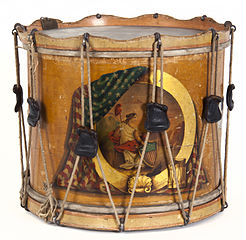
as the saviors of their country." (Right) First Minnesota Volunteers
drum. Courtesy Minnesota Historical Society. *Casualty
figures for the second day of Gettysburg are difficult to assess because both armies reported by unit after the full battle,
not by day. One estimate is that the Confederates lost approximately 6,000 killed, missing, or wounded from Hood's,
McLaws's, and Anderson's divisions, amounting to 30-40% casualties. Union casualties in these actions probably exceeded
9,000. The Union Army (1908) indicates that the First Minnesota sustained 224 casualties (killed and wounded). The Union
Army figures are debatable because sources vary and indicate between 36 and 48 reported for muster the evening following
the battle. Missing-in-action? None? This also appears to be an anomaly. But, on the other hand, perhaps not. Meanwhile, the
Regimental Historian (Lt. Wm. Lochren) recorded that the First Minnesota had 215 casualties, and recorded that 47 were
present for muster. Lochren subtracted the muster figures (262-47=215) (82.1%) and opined that "[every one of the] 215 [missing
men] lay upon the field." I have therefore posted the fact sheet by William F. Fox, Regimental Losses in the
American Civil War (1889), who is considered the foremost authority for Civil War casualties. Gettysburg National Military
Park, Lochren, and Fox report the exact casualty figures, while other sources vary slightly. What about the missing-in-action?
Since 47 were killed and 168 were wounded, the wounded are categorized as those who: later died from wounds (mortally wounded); unfit
for duty; and recovered and returned to duty. During the First Minnesota's charge, there was an ongoing massive
artillery barrage. Perhaps there were no missing; they, too, may have been blown to pieces by cannon. Nevertheless, sources
may vary slightly, but the fact remains that the First Minnesota fought valiantly on that bloody second day at Gettysburg. At the close of the year 1861
the state had furnished 4,400 men in its own regiments and companies, as well as several hundred who had joined the regiments
of other states. Her quota was 4,180. Cavalry was needed during and
after the Dakota Conflict to patrol the frontier and quickly react to threats. Only Brackett’s Battalion served outside
Minnesota and the Dakotas. Three companies of Brackett’s Battalion, Minnesota Cavalry, were part of the 5th Iowa Cavalry
from December 1861 to January 1864, thereafter with additional companies as an independent Minnesota battalion until
the summer of 1866. It served on the 1864 Northwestern Indian Expedition with the Eighth Minnesota Infantry and the Third
Battery Light Artillery. First Regiment of Mounted Rangers
(First Minnesota Cavalry) served on the 1863 Sibley Expedition with the Sixth, Seventh and Tenth Minnesota Infantry and the
Third Battery Minnesota Light Artillery. Second Regiment, Minnesota Cavalry, served on the 1864 Sully Northwestern Indian
Expedition with the Eighth Minnesota Infantry and Brackett's Battalion, Minnesota Cavalry. Two independent companies of
sharpshooters were raised in Minnesota to be part of Berdan’s United States Sharpshooters. The First Company became
Company A of the Second Regiment of United States Sharpshooters and served with them in the Army of the Potomac. The
Second Company of Minnesota Sharpshooters became Company L of the First Regiment of United States Sharpshooters, but was soon
detached and transferred as an additional company, again L, of the First Minnesota Infantry. They participated in most
of that unit’s actions until muster out in early 1864. The First and Second Light Artillery
batteries served under Grant and Sherman in the South and East while the Third Battery, raised in 1863, participated
in three campaigns against the Dakota. The Third Light Artillery Battery served on the 1863 Sibley Expedition with
the Sixth, Seventh and Tenth Minnesota Infantry and the Minnesota Mounted Rangers, and on 1864 Northwestern Indian Expedition
with the Eighth Minnesota Infantry and Brackett's Battalion Minnesota Cavalry. The Regiment of Heavy Artillery was raised
in late 1864 and garrisoned Chattanooga, Tennessee.
Prior to the Civil War, settlers
poured into Minnesota looking for cheap farmland. To accommodate this expanding settlement, Native Americans ceded lands to
the Federal government in the form of treaties. The Treaty of Traverse de Sioux of July 23, 1851, transferred most of southern
Minnesota to the Federal government. In return, the Dakota (also known as Sioux or Santee Sioux) would retain a reservation,
receive assistance in education, trade, and farming, and receive payments in food and gold. The Dakota were coerced to sign
the treaty. Moreover, the U.S. Senate refused to honor its commitments once the treaty was signed. Congress also redrew the
boundaries of the reservation, thus crowding the Dakota and limiting their means of survival. They were initially given a strip
of land of ten miles north and south of the Minnesota River, but they were later forced to sell the northern half of the land.
In 1862, crop failures left the Dakota with food shortages and the promised government money was delayed. After four
young Dakota men, searching for food, shot a family of white settlers near Acton, the Dakota leadership decided to continue
the attacks in an effort to drive out the settlers. Over a period of several days, Dakota attacks at the Lower Sioux Agency,
New Ulm and Hutchinson, as well as in the surrounding farmlands, resulted in the deaths of at least 300 to 400 white settlers
and government employees, causing panic in the settlements and provoking counterattacks by state militia and Federal forces
which spread throughout the Minnesota River Valley and as far away as the Red River Valley. Henry Hastings Sibley, former
US Congressman and first Governor of Minnesota (May 24, 1858 - January 2, 1860), was appointed colonel of the state
militia in 1862. Sibley's responsibilities included protecting the exposed settlements from the Sioux Indians. In 1862, Minnesota was still
a young state, part of a frontier inhabited by more than one million Indians. Times were hard and Indian families hungry.
When the U.S. government broke its promises, some of the Dakota Indians went to war against the white settlers. Many Dakota
did not join in, choosing to aid and protect settlers instead. The fighting lasted six weeks and many people on both sides
were killed or fled Minnesota. Former Minnesota Governor Henry Sibley led an expedition of soldiers and Dakota scouts against
the Dakota warriors. The war ended on December 26, 1862, when thirty-eight Dakota Indians were hanged in Mankato in the largest
mass execution in U.S. history. Afterwards the government forced most of the remaining Dakota to leave Minnesota. For white
Minnesotans, their experience of blood and terror negated all promises they had made to the Dakota. In August 1862, settlers on the
Minnesota frontier, frightened of a possible Indian conflict organized local, grass roots organizations for mutual protection
in dozens of cities and towns around Minnesota. Active campaigns against the Indians resulted in the battles of Birch Coulee,
Mankato, and New Ulm. An expedition, commanded by Colonel Henry H. Sibley and comprised of many of the citizen groups, was
also undertaken to remove the threat from any remaining hostile Indians. Although the Minnesota Adjutant General’s Office
sought to compensate the involved citizenry, compensation varied widely. Requests for payment were submitted to the Adjutant
General’s office and vouchers were created to authorize payment. These pay voucher ledger sheets (1862) document the
names, the amounts paid, and the voucher numbers assigned. These sheets were used by Judge Charles E. Flandrau, commander
of the forces at the Battle of New Ulm, to create the rosters that appear in Minnesota in the Civil and Indian Wars 1861-1865.
While Indian hostilities within the state ended in 1862, companies were formed in 1863, 1864, and 1865 that provided home
guard service. See also Minnesota in the Civil War (1861-1865).
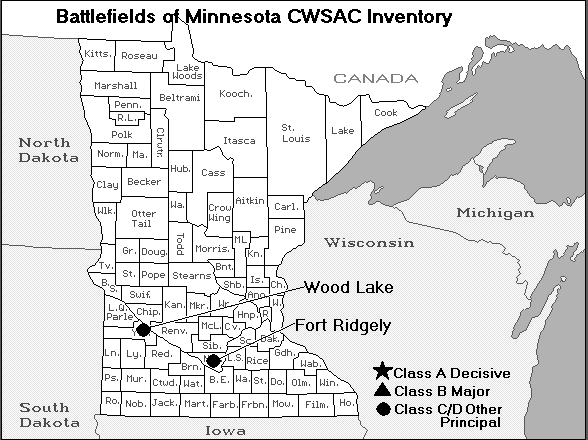
Battle of
Fort Ridgely In August 1862, the Santee
Sioux of Minnesota under Chief Little Crow, angered by the failure of the Federal government to provide annuities and by the
poor quality of rations, went on the offensive. They killed approximately 800 settlers and soldiers, took many prisoners,
and caused extensive property damage throughout the Minnesota River Valley. Fort Ridgely, about twelve miles from the Lower
Sioux Agency, became the refuge for white civilians. The fort’s commander, Capt. John S. Marsh, set out with most of
his men for the Lower Sioux Agency. Before reaching the agency, a large Native American force surprised the soldiers, killed
half of them, including Marsh, and pursued the survivors back to the fort. On August 20, about 400 Sioux attacked the fort
but were repulsed. On the 22nd, 800 Sioux attacked the fort again, but the garrison and civilians held the fort. The U.S.
had suffered 4 killed and 14 wounded, while Santee Sioux casualties were 2 killed and 5 wounded.
On September 19, 1862,
in the Battle of Wood Lake, Col. Henry Hastings Sibley set out from Fort Ridgely with 1,500 volunteers to put down the Santee
uprising. As they neared Wood Lake on September 23, Sibley’s men escaped an ambush by 700 warriors under Chief Little
Crow and engaged them in a battle. Sibley’s force won the day inflicting heavy casualties on the Sioux. For this action,
Sibley received a promotion to brigadier general. Wood Lake was the first decisive defeat of the Sioux since the uprising
began. The U.S. suffered nearly 40 casualties, and Santee Sioux casualties were between 7 and 15 killed. The battles at Fort Ridgely,
Birch Coulee, Fort Abercrombie, and Wood Lake punctuated a six-week war, which ended with the trial of 425 Native Americans
for their participation in the war. Of this number, 303 men were convicted and sentenced to death. Episcopal Bishop Henry
Benjamin Whipple petitioned President Abraham Lincoln for clemency, and the death sentences of all but 39 men were reduced
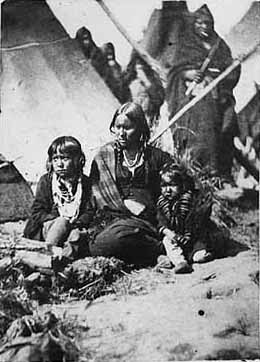
to prison terms. On December 26, 1862, 38 men were hanged in the largest mass execution in the United States. (Right) Little Crow's wife and two children at Fort
Snelling prison in 1864. Many of the remaining Dakota
Native Americans, including non-combatants, were confined in a prison camp at Pike Island over the winter of 1862-1863,
where more than 300 died of disease. Survivors were later exiled to the Crow Creek Reservation, then later to a reservation
near Niobrara, Nebraska. A small number of Dakota Native Americans managed to return to Minnesota in the 1880s and establish
communities near Granite Falls, Morton, Prior Lake, and Red Wing.
Aftermath During the aftermath, new railroad
construction shifted Minnesota's agricultural economy away from independent farmers and towards larger farms. Extensive wheat
fields and forests fueled growth in the flour milling and lumber industries. Following the Civil War, African
Americans received citizenship with the 14th Amendment to the U.S. Constitution, while American Indians, or Native Americans,
on the other hand, were not citizens for another half-century. On June 2, 1924, America's indigenous peoples became United
States citizens with passage of the Indian Citizenship Act of 1924. After the upheaval of the Civil
War and the Dakota War of 1862, the state's economy started to develop when natural resources were tapped for logging and
farming. Railroads attracted immigrants, established the farm economy, and brought goods to market. After the war, Minnesota
became an attractive region for European immigration and settlement as farmland. Minnesota's population in 1870 was 439,000;
this number tripled during the two subsequent decades. The Homestead Act in 1862 facilitated land claims by settlers, who
regarded the land as being cheap and fertile. The railroad industry, led by the Northern Pacific Railway and Saint Paul and
Pacific Railroad, advertised the many opportunities in the state and worked to get immigrants to settle in Minnesota. James
J. Hill, in particular, was instrumental in reorganizing the Saint Paul and Pacific Railroad and extending lines from the
Minneapolis-Saint Paul area into the Red River Valley and to Winnipeg. Hill was also responsible for building a new passenger
depot in Minneapolis, served by the landmark Stone Arch Bridge which was completed in 1883. During the 1880s, Hill continued
building tracks through North Dakota and Montana. In 1890, the railroad, now known as the Great Northern Railway, started
building tracks through the mountains west to Seattle. Other railroads, such as the Lake Superior and
Mississippi Railroad and the Milwaukee Road, also played an important role in the early days of Minnesota's statehood. Later
railways, such as the Soo Line and Minneapolis and St. Louis Railway facilitated the sale of Minneapolis flour and other products,
although they were not as involved in attracting settlers.
|
|
|
||||||||||||||||||||||||||||||||||||
|
||||||||||||||||||||||||||||||||||||||||
|
|
|
|
|
|
|
|
|
|
|
|
|
|
|
|
|
||||||||||||||||||||||||
|
|
|
|
|
|
|
|
|
|
|
|
|
|
|
|
|
||||||||||||||||||||||||
|
|
|
|
|
|
|
|
|
|
|
|
|
|
|
|
|
||||||||||||||||||||||||
|
|
|
|
|
|
|
|
|
|
|
|
|
|
|
|
|
||||||||||||||||||||||||
|
|
|
|
|
|
|
|
|
|
|
|
|
|
|
|
|
||||||||||||||||||||||||
|
||||||||||||||||||||||||||||||||||||||||
|
|
Sources: Library of Congress;
National Park Service; National Archives; Official Record of the Union and Confederate Armies; US Census Bureau; The Union
Army (1908); Fox, William F. Regimental Losses in the American Civil War (1889); Dyer, Frederick H. A Compendium of the War
of the Rebellion (1908); Phisterer, Frederick. Statistical record of the armies of the United States (1883); Hardesty, Jesse. Killed and died of wounds in the Union army during the Civil War (1915):
Wright-Eley Co.; Risjord, Norman K. (2005). A Popular History of Minnesota. Saint Paul, MN: Minnesota Historical Society Press.
ISBN 0-87351-532-3; Lass, William E. (1998) [1977]. Minnesota: A History (2nd ed.). New York, NY: W.W. Norton & Company.
ISBN 0-393-04628-1; Gilman, Rhoda R. (1991). The Story of Minnesota's Past. Saint Paul, Minnesota: Minnesota Historical Society.
ISBN 0-87351-267-7; Kaplan, Anne R.; Ziebarth, Marilyn (1999). Making Minnesota Territory, 1849-1858. St. Paul, MN:
Minnesota Historical Society. ISBN 978-0-87351-373-9; Kincannon, Charles Louis, ed. (2004). Census of Population & Housing
(2000): Summary Social, Economic & Housing Counts: U.S.. Washington, DC: U.S. Census Bureau; Lass, William E. (1998) [1977].
Minnesota: A History (2nd ed.). New York, NY: W.W. Norton & Company. ISBN 0-393-04628-1; Meinig, D.W. (1993). The Shaping
of America: A Geographical Perspective on 500 Years of History. 2. New Haven, CT: Yale University Press. p. 439. ISBN 0-300-05658-3;
Meyer, Roy Willard (1993). History of the Santee Sioux: United States Indian policy on trial. University of Nebraska Press.
ISBN 0-8032-8203-6; Minnesota Historical Society (1898). Collections of the Minnesota Historical Society. 8. St. Paul, MN:
Minnesota Historical Society; Neill, Edward Duffield (1858). The history of Minnesota: from the earliest French explorations
to the Present Time. Philadelphia: J. B. Lippincott & Co.; Neill, Edward Duffield (1881). Minnesota explorers and pioneers
from A.D. 1659 to A.D. 1858. North Star Publishing; Andrews, C. C., ed. (1891). Minnesota in the Civil and Indian Wars 1861-1865.
St. Paul, Minn: Printed for the state by the Pioneer Press Co.; Bircher, William. A Civil War Drummer Boy: The diary of William
Bircher, 1861-1865 (Mankato, MN: Blue Earth Books), 2000. ISBN 0-7368-0348-3; A drummer-boy's diary: comprising four
years of service with the Second Regiment Minnesota Veteran Volunteers, 1861 to 1865 (1889):Internet Archive; Bishop,
J. W. Official Records Concerning the Second Regiment, Minnesota Veteran Volunteer Infantry, 1887 (St. Paul, MN: H. M. Smyth
Print. Co.), 1887; Bishop, J. W. The Story of a Regiment: Being a Narrative of the Service of the Second Regiment, Minnesota
Veteran Volunteer Infantry, in the Civil War of 1861-1865 (St. Paul, MN: s.n.), 1890; Carley, Kenneth. Minnesota in the
Civil War (St. Paul, MN: Minnesota Historical Society Press), 2000. ISBN 0-87351-387-8; Christianson, Theodore, LL.D., L.H.D.
(1935). History of Minnesota, vol. IV. The American Historical Society, Inc.; Donahower, J. C. Lookout Mountain and Missionary
Ridge (Minnesota: s.n.), 1898; Griffin, D. B. Letters Home to Minnesota: 2nd Minnesota Vol. (Spokane, WA: P. D. Enterprises),
1992. ISBN 0-9630286-1-8; Imholte, John Q., The First Volunteers: History of the first Minnesota Volunteer Regiment, 1861-1865;
Minneapolis: Ross & Haines, 1963; Jones, Robert Huhn (1960). The Civil War in the Northwest. University of Oklahoma Press;
Moe, Richard, The Last Full Measure: The Life and Death of the First Minnesota Volunteers. St. Paul, MN: Minnesota Historical
Society Press, 1993, ISBN 978-087351406-4; Pendergast, T. H. Pen Pictures from the Second Minnesota: "Personal recollections
by a private soldier" and "Marching thro' Georgia" (Roseville, MN: Park Genealogical Books), 1998. ISBN 0-915709-58-9.
Return to American Civil War Homepage
|
|
|
||||||||||||||||||||||||||||||||||||
|
||||||||||||||||||||||||||||||||||||||||