Pennsylvania Civil War History
|
|
|
|
|
|
|
|
Pennsylvania Civil War History |
|
||
|
|
|
|
||
|
|
|
|
|
|
|
|||||
|
|
||||
|
|||||
|
||||||||||||||||||||||||||||||||||
|
|
Introduction Five days after Delaware received
statehood, Pennsylvania became the second state by ratifying the U.S. Constitution on December 12, 1787. Pennsylvania, officially the
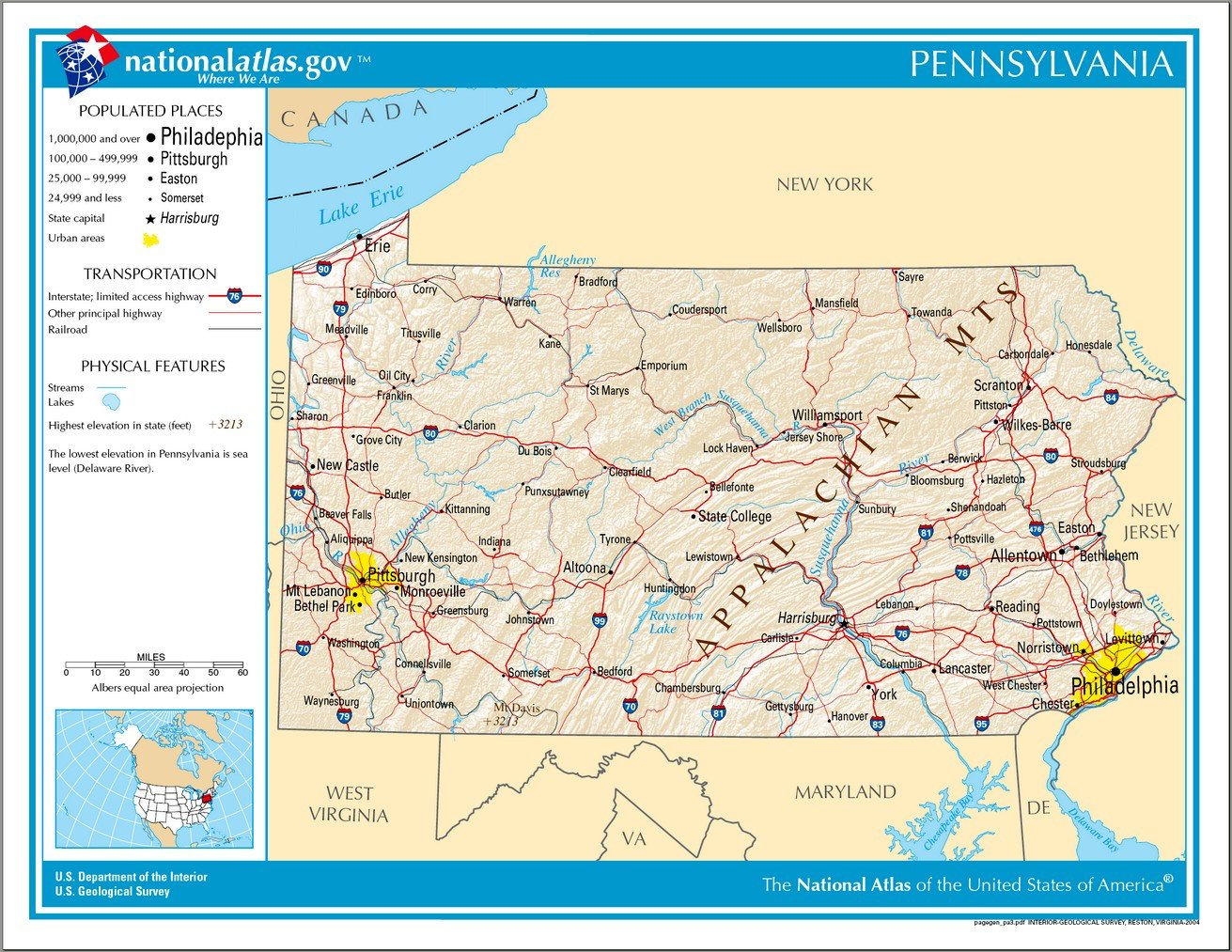
Commonwealth of Pennsylvania, is a U.S. state that is located in the Northeastern and Mid-Atlantic regions of the United States,
and the Great Lakes region. The state borders Delaware to the southeast, Maryland to the south, West Virginia to the southwest,
Ohio to the west, Lake Erie and Ontario, Canada to the northwest, New York to the north and New Jersey to the east. Before Pennsylvania was settled
by Europeans, the area was home to the Delaware (also known as Lenni Lenape), Susquehannock, Iroquois, Erie, Shawnee and other
Native American tribes. Most of these tribes were driven off or reduced to remnants as a result of the European colonization.
It was colonized by Dutch in 1631, who brought slaves into the colony, and subsequently colonized by Swedish settlers in 1638.
In 1664, the English conquered the area. The Province of Pennsylvania,
also known as Pennsylvania Colony, was founded in British America by William Penn on March 4, 1681, as dictated in a royal
charter granted by King Charles II. The name Pennsylvania, which translates roughly as "Penn's Woods", was created by combining
the Penn surname (in honor of William's father, Admiral Sir William Penn) with the Latin word sylvania, meaning "forest land".
The proprietary colony's charter remained in the hands of the Penn family until the American Revolution, when the Commonwealth
of Pennsylvania was created and became one of the original thirteen states. In the mid-eighteenth century, the colony attracted
many German and Scots-Irish immigrants; the latter was the largest ethnic group from the British Isles prior to the American
Revolutionary War.
(Right) A map of the Province
of Pennsylvania. During the American
Civil War (1861-1865), Pennsylvania played a critical role in the Union, providing a huge supply of military manpower, equipment,
and leadership to the Federal government. The state raised more than 360,000 soldiers for the Federal armies, and served as
a major source of artillery guns, small arms, ammunition, armor for ironclad United States Navy gunboats, and food supplies.
The Phoenixville Iron Company by itself produced well over 1,000 cannons, and the Frankford
Arsenal was a major supply depot. Pennsylvania was the site of
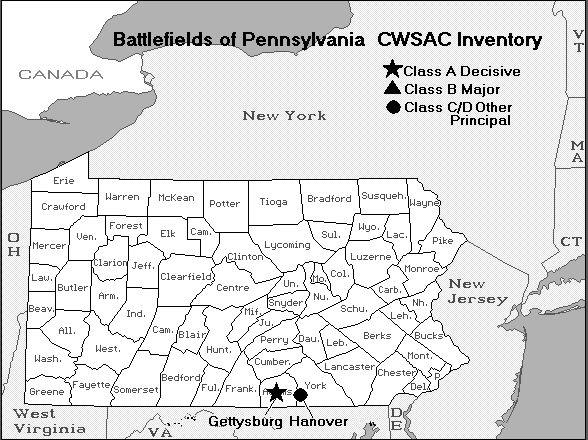
the bloodiest battle of the entire war, Gettysburg, which became widely known as the "High Water Mark of the Confederacy." Numerous
other smaller engagements were also fought in Pennsylvania during the 1863 Gettysburg Campaign and during an 1864 cavalry raid that culminated in the burning of much
of Chambersburg, Pennsylvania. The industrial town of York, Pennsylvania, was the largest city in the North to be occupied
by the Confederate States Army during the war. Several
leading generals and politicians hailed from the commonwealth, including George G. Meade (the victor at Gettysburg), Winfield
S. Hancock, John F. Reynolds, Simon Cameron and Thaddeus Stevens, a powerful and outspoken figure among the Radical
Republicans. Generals Montgomery C. Meigs and Herman Haupt made significant contributions to the military effort in logistics
and railroads, respectively.
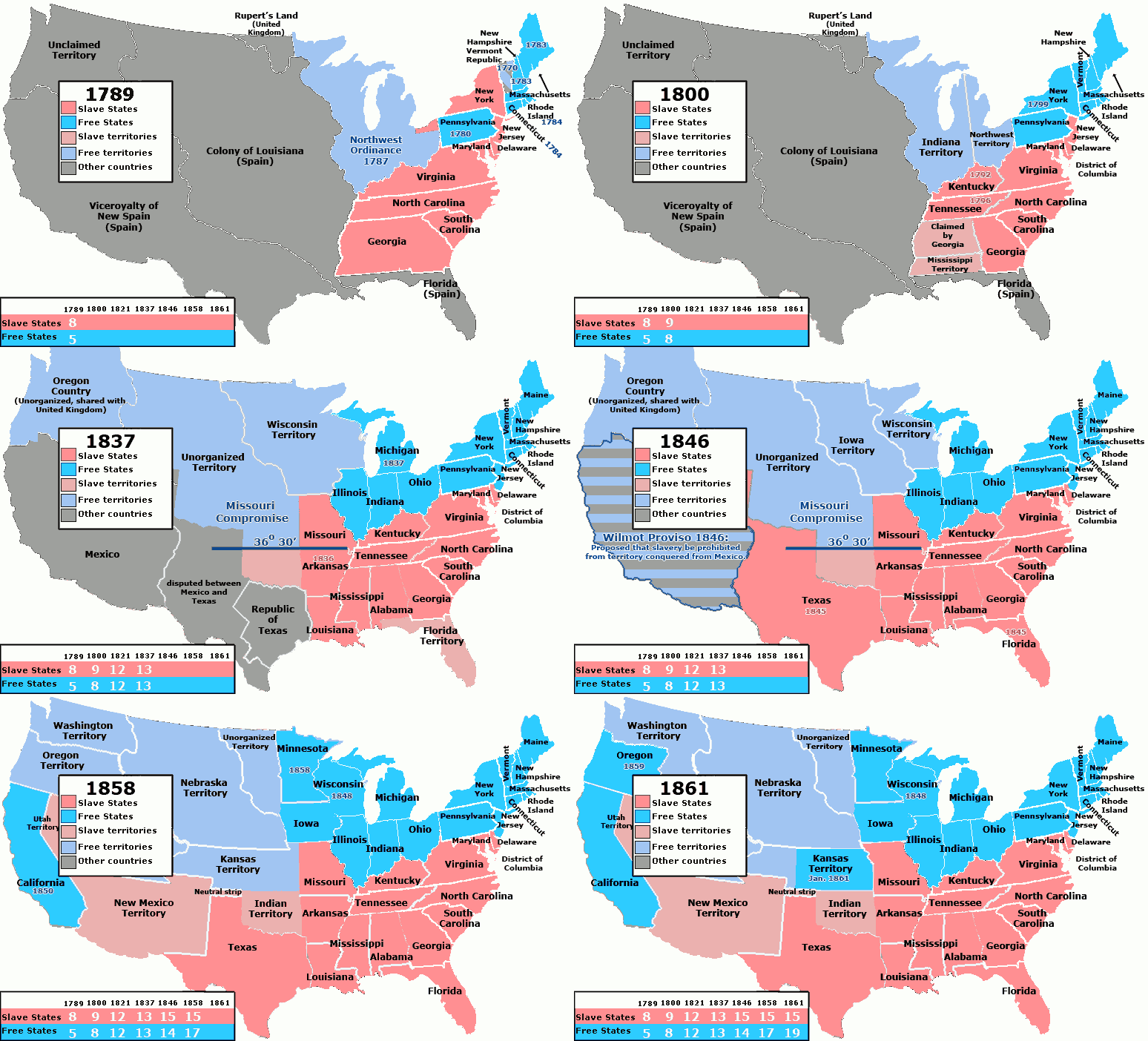
Slavery When the Dutch and Swedish
established colonies in the Delaware Valley, they quickly imported African slaves for workers, or transported them from New
Netherland; slavery was documented as early as 1639. After the founding of Pennsylvania in 1681, Philadelphia became the region's
main port for the import of slaves. Throughout the colony and state's history, the majority of slaves lived in or near that
city. William Penn and the colonists who settled Pennsylvania tolerated slavery,
but the Quakers and later German immigrants were among the first to speak out against it. Many Methodists and Baptists also
opposed it on religious grounds and urged manumission during the Great Awakening. High British tariffs in the 18th century
discouraged the importation of additional slaves, and encouraged the use of white indentured servants and free labor. After the American Revolutionary
War, Pennsylvania passed the Gradual Abolition Act (1780), the first such law in the new United States. Vermont abolished
slavery in its constitution of 1777. Pennsylvania's law established as free those children born to slave mothers after that
date. They had to serve lengthy periods of indentured servitude until age 28 before becoming fully free as adults. Emancipation
proceeded and by 1810 there were fewer than 1,000 slaves in the Commonwealth. None appeared in records after 1847. Sentiment James Buchanan (known as
the "Bachelor President"), of Franklin County, was the only President of the United States born in Pennsylvania. His successor
was Abraham Lincoln. During the 1860 Presidential
Election, Pennsylvania voted in favor of Abraham Lincoln (268,030 votes or 56.3% of the ballots cast) over Stephen Douglas
(178,765; 37.5%), John C. Breckinridge (16,765; 3.5%), and John Bell (12,776; 2.7%). Throughout the American
Civil War, Pennsylvania politics were dominated by Republicans under the capable leadership of Governor Andrew G. Curtin,
a strong supporter of President Lincoln. The extreme southern tier of the state included a fair number of Copperheads, particularly
in Fulton, Adams, and York counties. On the national level,
Simon Cameron served as Secretary of War during the early years of Lincoln's administration. Congressman Thaddeus Stevens
became one of the leading voices of the Radical Republicans in Washington, and was a hawk on the war efforts and in his harsh
views on Reconstruction. Stevens' Caledonia Iron Works were burned by Jubal A. Early's Confederates during the Gettysburg
Campaign in direct response to his strong stance supporting scorched earth policies in the South. After the Battle of Antietam
in fall of 1862, thirteen Union governors assembled in Altoona, Pennsylvania, at the Loyal War Governors' Conference. This
meeting was assembled by Governor Andrew G. Curtin and gave Abraham Lincoln the very much needed political power to support
the issuing of the Emancipation Proclamation. By late 1864,
the majority of Pennsylvania voters had rallied around the president and supported his incumbency in the Presidential Election,
giving Lincoln 296,292 votes or 51.6% of the ballots cast versus Maj. Gen. George B. McClellan's 277,443 votes (48.4%).
Mobilization In order to supply the
Union war effort, Pennsylvania industries turned their attention toward producing war material. The Alleghany Arsenal, Fort
Pitt Works, Frankford Arsenal, and Schuylkill Arsenal produced thousands of cannons, ammunition, and clothing. Additionally,
the Baldwin Locomotive Works assisted in building railroad engines that the armies used to transport troops and materials
during the war; the Philadelphia navy yard allowed for warships and supply ships to harbor; and coal mines across the commonwealth
helped keep these industries operating. Pennsylvania was a critical
source of raw materials to the Union war effort, particularly anthracite coal. The commonwealth supplied all of this "smokeless"
coal for military purposes, as well as the majority of bituminous coal also used in the war effort. Nearly 80% of all
the iron for the government came from Pennsylvania foundries, as well as significant quantities of flour, meat, foodstuffs,
textiles and uniforms. The Cumberland Valley was among the fertile farming regions that supplied vast amounts of food and
grain to the army. The railroads became critical in transporting materiel and troops. In particular, the Baltimore & Ohio
Railroad and the Pennsylvania Railroad were of importance, as well as the Northern Central Railway, which led from Harrisburg
to Baltimore, Maryland, and Washington, D.C. The Bethlehem Iron Works
produced railroad rails and armor plating for the US Navy ships. The largest producer of wrought iron artillery pieces for
the Union army was the Phoenixville Iron Company in Chester County, which, at its peak, churned out fifty 3" Ordnance Rifles
each week. Smaller facilities produced steel swords, rifles, pistols, tools, camp implements, tents and other items used by
the Federal armies, making Pennsylvania one of most important sources of government supplies during the war. The Philadelphia region
was a major contributor to the war effort. The Frankford Arsenal was a vital source of small-arms, ammunition, artillery shells,
and time fuses to the Federal army and state militia. The Philadelphia Navy Yard provided an important source of ships, sailors,
and supplies for the United States Navy during the war. The vast majority of the coal used by the Navy for its warships and
blockaders came from underground mines in several counties in northern Pennsylvania. The Satterlee Hospital and the Mower
Hospital (both near Philadelphia) were significant military hospitals and rehabilitation centers, as was the York U.S. Army
General Hospital. Pittsburgh's heavy industry
provided significant quantities of weapons and ammunition. The Fort Pitt Works near Pittsburgh made mammoth iron castings
for giant siege howitzers and mortars, among the largest guns in the world. The foundry produced 1,193 guns (15 percent of
the total U.S. wartime artillery production) and almost 200,000 artillery projectiles. Other prominent Pittsburgh area factories
included Singer, Nimick and Co. (maker of 3" Ordnance rifles) and Smith, Park and Co., which produced more than 300,000 artillery
projectiles. Pittsburgh industries collectively manufactured 10 percent of the total U.S. wartime production of artillery
projectiles. The U.S. Allegheny Arsenal
was the primary military manufacturing facility for U.S. Army accouterments, as well as saddles and other cavalry equipment.
In addition, the Allegheny Arsenal produced as many as 40,000 bullets and cartridges every day (more than 14 million per year),
supplying between 5 and 10 percent of the Army's annual small arms ammunition requirements. Five Ellet-class rams were converted
from civilian towboats at Pittsburgh. In addition, four ironclads were built from the keel up: the USS Manayunk, Marietta,
Sandusky, and Umpqua. Pittsburgh rolling mills supplied the armor for many of the ironclads that were built in New York and
Philadelphia. Civil War According to the 1860 US
census, Pennsylvania had a population of 2,906,215. Approximately 360,000 Pennsylvanians
served in the Union Army, more than any other Northern state except New York. Beginning with President Lincoln's first call
for troops and continuing throughout the war, Pennsylvania mustered 215 infantry regiments, as well as dozens of emergency
militia regiments that were raised to repel threatened invasions in 1862 and 1863 by the Confederate States Army. Twenty-two
cavalry regiments were also mustered, as well as dozens of light artillery batteries. The vast majority of Pennsylvania
soldiers fought in the Eastern Theater, with only about 10% serving elsewhere. The thirteen regiments of the Pennsylvania
Reserves fought as the only army division all from a single state, and saw action in most of the major campaigns and battles
of the Army of the Potomac. The Philadelphia Brigade was also a rarity, in that all of its regiments were recruited from a
single city. In an unusual circumstance, the Philadelphia Corn Exchange sponsored and paid for a regiment, the 118th, which
became known as the "Corn Exchange Regiment."
Leading major generals
from Pennsylvania included Winfield S. Hancock, John F. Reynolds, Samuel W. Crawford, John W. Geary, and John F. Hartranft
(the latter two would use their military careers to propel them to the governorship following the war). Although he was born
in Spain, George G. Meade lived much of his life in Pennsylvania and is buried in Philadelphia. Herman Haupt, who commanded
the U.S. Military Railroad, revolutionized military transportation in the United States and was one of the unsung heroes of
the war. Significant naval leaders included Admiral David D. Porter and Rear Admiral John Dahlgren. As a result of its vital
role as a Federal raw material source and its proximity to the Mason-Dixon Line, Pennsylvania was the target of several raids
by the Confederate States Army. These included cavalry raids in 1862 and 1863 by J.E.B. Stuart, in 1863 by John Imboden, and
in 1864 by John McCausland in which his troopers burned the city of Chambersburg. Fears were raised in Pittsburgh in the summer
of 1863 when Morgan's Raid approached Pennsylvania before it was thwarted in neighboring Ohio. Pennsylvania soil was also host
to the Battle of Gettysburg. Many historians consider this battle to be a major turning point of the Civil War. Federal dead
from this battle rest at Gettysburg National Cemetery, site of Abraham Lincoln's Gettysburg Address. A number of smaller engagements
were also fought in the Keystone State, including the Battle of Hanover, Battle of Carlisle, Battle of Hunterstown, and the
Battle of Fairfield, all during the Gettysburg Campaign. The city of York, Pennsylvania, became the
largest Northern city to be occupied by Confederate troops when Jubal A. Early's division took control of the town in late
June 1863 and extracted a ransom. Chambersburg On October 10, 1862, Confederate
Maj. Gen. J.E.B. Stuart, with 1800 cavalrymen, raided Chambersburg, destroying $250,000 of railroad property and taking 500
guns, hundreds of horses, and at least "eight young colored men and boys." They failed, however, to accomplish one of the
main targets of the raid: to burn the railroad bridge across the Conococheague Creek at Scotland, five miles north of town. During the early days of
the 1863 Gettysburg Campaign, a Virginia cavalry brigade under Brig. Gen. Albert G. Jenkins occupied the town and burned several
warehouses and Cumberland Valley Railroad structures and the bridge at Scotland. From June 24-28, 1863, much of the
Army of Northern Virginia passed through Chambersburg en route to Carlisle and Gettysburg, and Robert E. Lee established his
headquarters at a nearby farm. The following year, Chambersburg
was invaded for a third time, as cavalry dispatched from the Shenandoah Valley by Jubal Early arrived. On July 30, 1864, a
large portion of the town was burned down under orders from Brig. Gen. John McCausland for failing to provide a ransom of
$500,000 in US currency, or $100,000 in gold. Among the few buildings left standing was the Masonic Temple, which had been
guarded under orders by a Confederate mason. Norland, the home of Republican politician and editor Alexander McClure, was
burned even though it was well north of the main fire.
Gettysburg
The Battle of Gettysburg
was fought July 1-3, 1863, in and around the town of Gettysburg, Pennsylvania. It was the battle with the largest number
of casualties in the American Civil War and is often described as the war's turning point. Union Maj. Gen. George Gordon Meade's
Army of the Potomac defeated attacks by Confederate Gen. Robert E. Lee's Army of Northern Virginia, ending Lee's invasion
of the North. After his success at Chancellorsville
in Virginia in May 1863, Lee led his army through the Shenandoah Valley to begin his second invasion of the North—the
Gettysburg Campaign. With his army in high spirits, Lee intended to shift the focus of the summer campaign from war-ravaged
northern Virginia and hoped to influence Northern politicians to give up their prosecution of the war by penetrating as far
as Harrisburg, Pennsylvania, or even Philadelphia. Prodded by President Abraham Lincoln, Maj. Gen. Joseph Hooker moved his
army in pursuit, but was relieved just three days before the battle and replaced by Meade. Elements of the two armies
initially collided at Gettysburg on July 1, 1863, as Lee urgently concentrated his forces there, with his objective being
to engage the Union army and destroy it. Low ridges to the northwest of town were defended initially by a Union cavalry division
under Brig. Gen. John Buford, and soon reinforced with two corps of Union infantry. However, two large Confederate corps assaulted
them from the northwest and north, collapsing the hastily developed Union lines, sending the defenders retreating through
the streets of town to the hills just to the south. On the second day of battle,
most of both armies had assembled. The Union line was laid out in a defensive formation resembling a fishhook. In the late
afternoon of July 2, Lee launched a heavy assault on the Union left flank, and fierce fighting raged at Little Round Top,
the Wheatfield, Devil's Den, and the Peach Orchard. On the Union right, demonstrations escalated into full-scale assaults
on Culp's Hill and Cemetery Hill. All across the battlefield, despite significant losses, the Union defenders held their lines.
On the third day of battle, July
3, fighting resumed on Culp's Hill, and cavalry battles raged to the east and south, but the main event was a dramatic infantry
assault by 12,500 Confederates against the center of the Union line on Cemetery Ridge, known as Pickett's Charge. The charge
was repulsed by Union rifle and artillery fire, at great losses to the Confederate army. Lee led his army on a torturous retreat
back to Virginia. Between 46,000 and 51,000 soldiers from both armies were casualties in the three-day battle. That November,
President Lincoln used the dedication ceremony for the Gettysburg National Cemetery to honor the fallen Union soldiers and
redefine the purpose of the war in his historic Gettysburg Address. See also Ten Bloodiest and Costliest Battles of the
American Civil War. On November 19, 1863, following
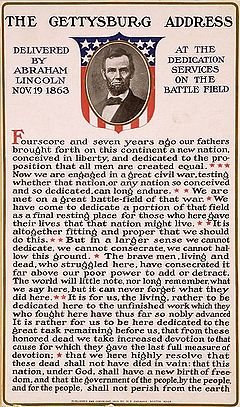
the Battle of Gettysburg, President Abraham Lincoln delivered The Gettysburg Address at the Soldiers’ National Cemetery
in Gettysburg, Pennsylvania: "Fourscore and seven years ago
our fathers brought forth on this continent a new nation, conceived in liberty and dedicated to the proposition that all men
are created equal. Now we are engaged in a great civil war, testing whether that nation or any nation so conceived and so
dedicated can long endure. We are met on a great battlefield of that war. We have come to dedicate a portion of that field
as a final resting-place for those who here gave their lives that that nation might live. It is altogether fitting and proper
that we should do this. But in a larger sense, we cannot dedicate, we cannot consecrate, we cannot hallow this ground. The
brave men, living and dead who struggled here have consecrated it far above our poor power to add or detract. The world will
little note nor long remember what we say here, but it can never forget what they did here. It is for us the living rather
to be dedicated here to the unfinished work which they who fought here have thus far so nobly advanced. It is rather for us
to be here dedicated to the great task remaining before us--that from these honored dead we take increased devotion to that
cause for which they gave the last full measure of devotion--that we here highly resolve that these dead shall not have died
in vain, that this nation under God shall have a new birth of freedom, and that government of the people, by the people, for
the people shall not perish from the earth."
Aftermath While Pennsylvania's farms increased
in value following the war, Philadelphia and Pittsburgh became manufacturing centers in an industrial boom. While
the war still raged, efforts were underway in Gettysburg to preserve portions of the battlefield for future generations as
a tribute to those men who fought there. Pennsylvania also took steps to preserve and record the history of each regiment
and unit raised in the state, as well as the muster rolls. In 1869, the official commonwealth historian Samuel Penniman Bates
wrote the monumental five-volume History of the Pennsylvania Volunteers, 1861-1865, which remains the standard reference
for the commonwealth's regimental histories and unit rosters. The State Archives in Harrisburg
preserves the military records of the state's emergency militia, as well as material on the state's volunteer regiments and
batteries. It also houses microfilmed records of the damage claims from individuals in several counties, delineating losses
of their personal property and possessions to the opposing armies during the Gettysburg Campaign. The Pennsylvania Capitol
Preservation Committee maintains and preserves 390 battleflags from various Pennsylvania units. The State Museum of Pennsylvania
houses an extensive general collection of Civil War artifacts, as well as Peter Rothermel's massive painting of the Battle
of Gettysburg. The National Civil War
Museum in Harrisburg is one of the country's leading interpretive sites for the Civil War, and the Visitors Center at the
Gettysburg Battlefield holds thousands of artifacts, including the largest collection of vintage Civil War weapons in Pennsylvania.
Other Civil War-related museums are scattered throughout the state, as well as county archives and hundreds of memorials,
monuments, and historical markers. An impressive state-sponsored monument in the Gettysburg National Military Park honors
Pennsylvania's soldiers and leaders.
|
|
|
||||||||||||||||||||||||||||||
|
||||||||||||||||||||||||||||||||||
|
|
|
|
|
|
|
|
|
|
|
|
|
|
|
|
|
||||||||||||||||||
|
|
|
|
|
|
|
|
|
|
|
|
|
|
|
|
|
||||||||||||||||||
|
|
|
|
|
|
|
|
|
|
|
|
|
|
|
|
|
||||||||||||||||||
|
|
|
|
|
|
|
|
|
|
|
|
|
|
|
|
|
||||||||||||||||||
|
|
|
|
|
|
|
|
|
|
|
|
|
|
|
|
|
||||||||||||||||||
|
||||||||||||||||||||||||||||||||||
|
|
Sources: National Park Service;
National Archives; Library of Congress; US Census Bureau; The Union Army (1908); Fox, William F. Regimental Losses in the
American Civil War (1889); Phisterer, Frederick. Statistical Record of the Armies of the United States (1883); Dyer, Frederick H. A Compendium of the War of the Rebellion (1908); Hardesty, Jesse.
Killed and died of wounds in the Union army during the Civil War (1915): Wright-Eley Co.; Official
Records of the Union and Confederate Armies; Bates, Samuel P., Military History of Pennsylvania, Philadelphia: T. H. Davis
& Company, 1876; Blair, William and William Pencak, eds., Making and Remaking Pennsylvania's Civil War, Penn State
Press, 2001 ISBN 0-271-02079-2; Klein, Philip Shriver, A History of Pennsylvania. Penn State University Press, 1980. ISBN
0-271-01934-4; Sauers, Richard A., Advance the Colors: Pennsylvania Civil War Battle Flags, Harrisburg: Capitol Preservation
Committee, 1991; U.S. War Department, The War of the Rebellion: A Compilation
of the Official Records of the Union and Confederate Armies, 70 volumes in 4 series. Washington, D.C.: United States Government
Printing Office, 1880-1901; Bearss, Edwin C. Fields of Honor: Pivotal Battles of the Civil War. Washington, D.C.: National
Geographic Society, 2006. ISBN 0-7922-7568-3; Busey, John W., and David G. Martin. Regimental Strengths and Losses at
Gettysburg, 4th ed. Hightstown, NJ: Longstreet House, 2005. ISBN 0-944413-67-6; Carmichael, Peter S., ed. Audacity Personified:
The Generalship of Robert E. Lee. Baton Rouge: Louisiana State University Press, 2004. ISBN 0-8071-2929-1; Catton, Bruce.
Glory Road. Garden City, NY: Doubleday and Company, 1952. ISBN 0-385-04167-5; Clark,
Champ, and the Editors of Time-Life Books. Gettysburg: The Confederate High Tide. Alexandria, VA: Time-Life Books, 1985. ISBN
0-8094-4758-4; Coddington, Edwin B. The Gettysburg Campaign; a study in command.
New York: Scribner's, 1968. ISBN 0-684-84569-5; Donald, David Herbert. Lincoln.
New York: Simon & Schuster, 1995. ISBN 0-684-80846-3; Eicher, David J. The
Longest Night: A Military History of the Civil War. New York: Simon & Schuster, 2001. ISBN 0-684-84944-5; Esposito, Vincent J. West Point Atlas of American Wars. New York: Frederick A. Praeger, 1959. OCLC 5890637; Foote, Shelby. The Civil War: A Narrative. Vol. 2, Fredericksburg to Meridian. New
York: Random House, 1958. ISBN 0-394-49517-9; Fuller, Maj. Gen. J. F. C. Grant
and Lee: A Study in Personality and Generalship. Bloomington: Indiana University Press, 1957. ISBN 0-253-13400-5; Gallagher, Gary W. Lee and His Army in Confederate History. Chapel Hill: University of North Carolina Press,
2001. ISBN 978-0-8078-2631-7; Gallagher, Gary W. Lee and His Generals in War and
Memory. Baton Rouge: Louisiana State University Press, 1998. ISBN 0-8071-2958-5; Glatthaar,
Joseph T. General Lee's Army: From Victory to Collapse. New York: Free Press, 2008. ISBN 978-0-684-82787-2; Harman, Troy D. Lee's Real Plan at Gettysburg. Mechanicsburg, PA: Stackpole Books, 2003. ISBN 0-8117-0054-2; Hattaway, Herman, and Archer Jones. How the North Won: A Military History of the Civil
War. Urbana: University of Illinois Press, 1983. ISBN 0-252-00918-5; Longacre,
Edward G. The Cavalry at Gettysburg. Lincoln: University of Nebraska Press, 1986. ISBN 0-8032-7941-8; McPherson, James M. Battle Cry of Freedom: The Civil War Era. Oxford History of the United States. New York:
Oxford University Press, 1988. ISBN 0-19-503863-0; Martin, David G. Gettysburg
July 1. rev. ed. Conshohocken, PA: Combined Publishing, 1996. ISBN 0-938289-81-0; Nye,
Wilbur S. Here Come the Rebels! Dayton, OH: Morningside House, 1984. ISBN 0-89029-080-6; Pfanz,
Harry W. Gettysburg - The First Day. Chapel Hill: University of North Carolina Press, 2001. ISBN 0-8078-2624-3; Pfanz, Harry W. Gettysburg - The Second Day. Chapel Hill: University of North
Carolina Press, 1987. ISBN 0-8078-1749-X; Pfanz, Harry W. Gettysburg: Culp's Hill
and Cemetery Hill. Chapel Hill: University of North Carolina Press, 1993. ISBN 0-8078-2118-7; Rawley, James A. Turning Points
of the Civil War. Lincoln: University of Nebraska Press, 1966. ISBN 0-8032-8935-9; Sauers,
Richard A. "Battle of Gettysburg." In Encyclopedia of the American Civil War: A Political, Social, and Military History, edited
by David S. Heidler and Jeanne T. Heidler. New York: W. W. Norton & Company, 2000. ISBN 0-393-04758-X; Sears, Stephen W. Gettysburg. Boston: Houghton Mifflin, 2003. ISBN 0-395-86761-4; Symonds, Craig L. American Heritage History of the Battle of Gettysburg. New York: HarperCollins, 2001.
ISBN 0-06-019474-X; Tagg, Larry. The Generals of Gettysburg. Campbell, CA: Savas
Publishing, 1998. ISBN 1-882810-30-9; Trudeau, Noah Andre. Gettysburg: A Testing
of Courage. New York: HarperCollins, 2002. ISBN 0-06-019363-8; Tucker, Glenn.
High Tide at Gettysburg. Dayton, OH: Morningside House, 1983. ISBN 978-0-914427-82-7; Wert,
Jeffry D. Gettysburg: Day Three. New York: Simon & Schuster, 2001. ISBN 0-684-85914-9; White,
Ronald C., Jr. The Eloquent President: A Portrait of Lincoln Through His Words. New York: Random House, 2005. ISBN 1-4000-6119-9; Wittenberg, Eric J., J. David Petruzzi, and Michael F. Nugent. One Continuous Fight:
The Retreat from Gettysburg and the Pursuit of Lee's Army of Northern Virginia, July 4-14, 1863. New York: Savas Beatie,
2008. ISBN 978-1-932714-43-2; Woodworth, Steven E. Beneath a Northern Sky: A Short
History of the Gettysburg Campaign. Wilmington, DE: SR Books (scholarly Resources, Inc.), 2003. ISBN 0-8420-2933-8.
Return to American Civil War Homepage
|
|
|
||||||||||||||||||||||||||||||
|
||||||||||||||||||||||||||||||||||