Abraham Lincoln : President
|
|
|
|
|
|
|
|
Abraham Lincoln : President |
|
||
|
|
|
|
||
|
|
|
|
|
|
|
|||||
|
|
||||
|
|||||
|
||||||||||||||||||||||
|
|
|
|
|
||||||||||||||||||
|
||||||||||||||||||||||
|
|
|
|
|
|
|
|
|
|
|
||||||||||||
|
|
|
|
|
|
|
|
|
|
|
||||||||||||
|
|
|
|
|
|
|
|
|
|
|
||||||||||||
|
|
|
|
|
|
|
|
|
|
|
||||||||||||
|
|
|
|
|
|
|
|
|
|
|
||||||||||||
|
||||||||||||||||||||||
|
|
A neighbor described the
Kentucky cabin in which Lincoln was born on February 12th, 1809 as "a hunters hut not fit to be called home." Few leaders
have started from more humble beginnings than Abe Lincoln. While his parents, Tom and Nancy, could provide limited material
needs, they apparently did foster Lincoln’s sense of compassion and concern for others. In 1816, the Lincolns moved
from Kentucky to Indiana where slavery was not condoned. Young Abraham's sensitivity to social injustice was apparent early
in life. One of his childhood friends, Elizabeth Crawford, recalled how he loved giving speeches and debating other children.
She said his favorite topic was discussing who had the greater right to complain—slaves or Indians. Lincoln's mother provided
much of his early education. She was a rarity on the frontier, in that she could read. Young Lincoln seldom was without a
book and spent hours studying Shakespeare, Byron, and even Euclid's geometry. Despite having little formal education, he triumphed
with determination. Lincoln ultimately developed a talent for expression rarely equaled by others.
(The
Lincoln family lived on 30 acres of the 228 acre Knob Creek Farm in Kentucky from the time Abraham was two and a half
until he was almost eight years old.)
Lincoln embarked on a political
career in the mid-1830s with his election to the Illinois State Legislature. Lincoln idolized the Founding Fathers whose grand
experiment in popular government sought liberty for all. Henry Clay of Kentucky became his political model. Clay, like Lincoln,
was born into a poor farm family. Despite the obstacles, Clay went on to the U.S. Senate and international fame. Lincoln felt that thanks
to the rights bestowed by the Declaration of Independence "in this country, one can scarcely be so poor, but that, if he will,
he can acquire sufficient education to get through the world respectably." Lincoln proved that point exactly by teaching himself
enough about law to gain admission to the Illinois Bar in 1837. Lincoln's life, begun so modestly, had changed dramatically.
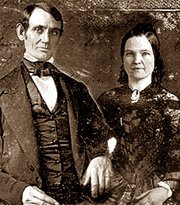
Marriage to the socially prominent Mary Todd in 1842 brought status and produced a family of four sons. Elected to the U.S. House
of Representatives in 1846, Lincoln was in Washington, D.C. on Independence Day 1848 to witness the Washington Monument cornerstone
laying ceremony. That evening, President James Knox Polk announced that all parties had reached agreement over the terms of
the earlier ratified treaty ending the Mexican War. Lincoln had opposed the war and the Mexican cession of land following
the victory of United States forces. Lincoln’s opposition to the war cost him his bid for reelection. By the 1850s, Lincoln was
one of the more respected attorneys in Illinois. The majority of his work was in the state's Supreme Court where he participated
in more than 240 cases, winning most of them. Despite these successes, Lincoln still suffered from bouts of depression, sorrow
over the death of his son Edward Baker Lincoln, and disappointment after two failed runs for the U.S. Senate. Undaunted, he
again found a way to overcome adversity. The 1858 U.S. Senate race,
during which he debated Stephen A. Douglas, catapulted Lincoln into a national spotlight. The famous Lincoln-Douglas Debates
set the stage for Lincoln’s eventual presidential nomination by the Republican Party in 1860. His trademark ambition
as well as his principled beliefs of equal rights and a united democracy, led to victory. Despite winning barely
forty percent of the popular vote in 1860, Lincoln symbolized a united Republican Party versus a fragmented Democratic Party
that had split between northern and southern factions over the issue of slavery. In reaction to his election, South Carolina
voted in December to secede from the Union, paving the way for six other states of the Deep South to follow suit throughout
early 1861.
In the midst of these developments,
a crowd had gathered in Springfield, Illinois to watch the departure of President-elect Lincoln for Washington. Lincoln declared
that he was to assume a task "greater than that which rested upon Washington." The first president's struggle to hold the
fledgling Union together was a debt that Lincoln felt compelled to repay. To fail would mean dissolution of that experiment
for which so many others had fought and died. For twelve days, the president-elect's
train moved east, stopping in several northern cities and towns where Lincoln delivered short speeches. Recognizing at one
stop the power of a symbol, Lincoln clutched the folds of an American flag while appealing to his audience to stand by him,
as he by the flag. Inside Philadelphia's Independence Hall, he asserted his reverence for the Declaration of Independence,
which provided "hope to the world for all future time." Here, Lincoln admitted that he "would rather be assassinated" than
surrender the principles of the Declaration. Abraham Lincoln’s
inaugural ceremonies elicited all the normal excitement, but the presence of armed soldiers along Pennsylvania Avenue and
atop the Capitol proved that these were extraordinary times. On March 4, 1861, Abraham Lincoln affirmed his charge to "preserve,
protect, and defend the Constitution of the United States." Just before taking the
presidential oath, Lincoln reminded his "dissatisfied fellow-countrymen" of the South, that he refused "to interfere with…slavery"
where it already existed and that they alone bore the onus of commencing civil war. He concluded his address by predicting
that "the mystic chords of memory, stretching from every battlefield and patriot grave" would "yet swell the chorus of the
Union, when again touched…by the better angels of our nature." His faith in such lofty sentiments surely would be tested
in short order. Throughout April 1861,
hopes for compromise and mediation quickly faded. The seceded states already had banded together to form the Confederate States
of America, elect a president, and create a Confederate Congress. In South Carolina, Confederate forces had bombarded a U.S.
installation, Fort Sumter in Charleston harbor, and forced capitulation of its garrison. War loomed. President Lincoln’s
appeal for 75,000 volunteers to suppress rebellion invigorated the North, which rallied overwhelmingly in support of the Union.
This exhibition of federal power, however, galvanized the southern people and propelled the states of the Upper South into
the Confederacy. Soldier cantonments soon
appeared throughout Washington, D.C., with northern volunteers finding accommodations inside several public buildings, including
the White House, Treasury Department, Patent Office, and the U.S. Capitol. The threat of attack from Confederate troops in
Northern Virginia necessitated construction of a fortifications ring that transformed the capital into an armed encampment.
The awful specter of the
incomplete Capitol dome seemed to reflect the fractured Union itself. Not so for those building it or for Lincoln, who sought
to equate continued work on it with continued work to preserve the Union it symbolized. Operating within his secured
capital, Lincoln acknowledged that civil war necessitated "bending" the Constitution. Wielding extensive wartime authority,
the Commander-in-Chief authorized the suspension of the writ of habeas corpus. The Constitution empowered only the Congress
to "suppress Insurrection" through such means, but Lincoln claimed that the magnitude of the situation allowed the executive
to take such action. Congress later approved his actions. Equating rebellion against
the Government of the United States with an attack on the Constitution itself, Lincoln reasoned that his oath of office required
him to take action. Lincoln wondered why those who vilified him for his actions also tolerated the actions of those who sought
to destroy that which he sought to preserve. The states and rivers became
war zones, and while at sea, the Union Navy blockaded southern ports. Lincoln soon realized that Union preservation demanded
measures beyond those that the military alone could provide. Battlefield victory at Antietam Creek, or Sharpsburg, Maryland
in September 1862, allowed Lincoln to issue the Emancipation Proclamation. This war measure freed only those slaves directly
sustaining the Confederate war effort, but it helped stave off European recognition. Not everyone in the North
agreed with the war's new direction, but there was no going back to the Union as it was. From the beginning Lincoln admitted
that the "struggle" was "for a vast future also," and credited the Founders with establishing the Union as a trial framework
within which every person would achieve liberty and equality. At the Soldiers' National
Cemetery dedication ceremony in Gettysburg, Pennsylvania, Lincoln characterized the "great civil war" by 1863 as a test of
the Union's longevity and acknowledged national indebtedness to those whose deaths upheld the experiment while purchasing
"a new birth of freedom." How better to expedite the latter, than to incorporate freed blacks into military service as segregated
units? The "promise of freedom" would offer a great inducement, Lincoln felt. As wartime leader, Lincoln
experienced great tragedy. Mirroring the country during wartime, the Lincolns bore great losses, none more devastating than
the 1862 death of their son, Willie. At several points, the war itself threatened the Lincolns’ own safety, especially
when an 1864 Confederate raid tapped the capital's northern fortifications and Lincoln himself came under fire. During his uncertain 1864
reelection campaign, those who sought to portray Lincoln as an abolitionist crusader tested his devotion to emancipation.
He continually asserted that Union was the war's "sole purpose," while avoiding discussion of his plans for reconstruction.
Once Federal battlefield successes ensured his continuation in office, he confidently announced that southern acceptance of
emancipation was a requirement for reunification. April 1865 delivered victory-the
Union restored. The end of the war also tested the rules of grammar. No longer could one say or write that the United States
were seeking reunification, for now one had to say or write that the United States was seeking reunification.
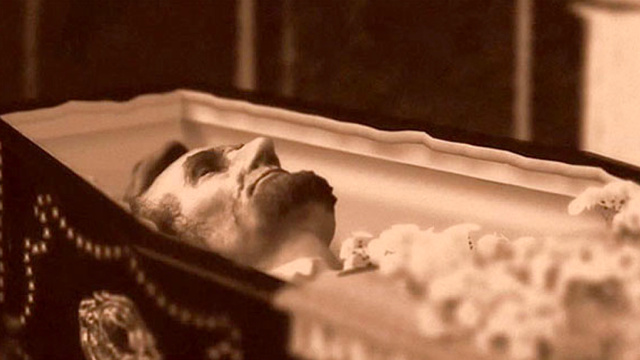
An assassin's bullet converted
the savior of the Union into a martyr, but failed to overthrow the man's mission. Others advanced Lincoln's work for more
than a century, ensuring that Constitutional Amendments and federal legislation provided all Americans with the benefits of
freedom, citizenship, and suffrage. Abraham Lincoln now rests
in Oak Ridge Cemetery in Springfield, Illinois. There, he lies, with his wife and three of his sons, as perhaps the most revered
figure in American history. He rose from obscurity, worked hard to achieve greatness, guided the Ship of State through its
most critical period, and gave his life for his country. Truly, his life was the story of the United States of America. See
also President Abraham Lincoln Homepage.
Return to American Civil War Homepage
|
|
|
||||||||||||||||||
|
||||||||||||||||||||||
|
||||||||||||||||||||||