Seven Days Battles
|
|
|
|
|
|
|
|
Seven Days Battles |
|
||
|
|
|
|
||
|
|
|
|
|
|
|
|||||
|
|
||||
|
|||||
|
||||||||||||||||||||||||||||||||||||
|
|
Introduction The Seven Days Battles, aka Seven
Days Campaign, fought June 25-July 1, 1862, were the decisive engagements of the Peninsula Campaign during the American
Civil War (1861-1865). Union general George B. McClellan had attempted to march his Army of the Potomac up the Peninsula
between the York and James rivers but was stalled first at Yorktown, then at Williamsburg, and finally at the fierce battle
at Seven Pines-Fair Oaks (May 31-June 1), during which Confederate general Joseph E. Johnston was severely wounded.
General Robert E. Lee assumed command of the Army of Northern Virginia and, to prevent a siege of the Confederate capital
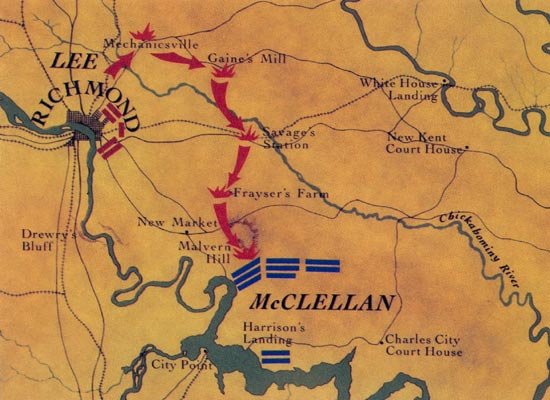
at Richmond, went on the offensive. The first of Lee's attacks occurred on June 26, and after two days of fighting he forced
McClellan to abandon his supply line and begin a retreat back to the James River. Lee pursued and came close to destroying
the Union army on June 30 at Glendale. He suffered a major tactical defeat the next day at Malvern Hill, but McClellan ensured
a Confederate strategic victory by continuing his retreat to Harrison's Landing. The battles ended McClellan's campaign to
take Richmond.
|
|
|
||||||||||||||||||||||||||||||||
|
||||||||||||||||||||||||||||||||||||
|
|
|
|
|
|
|
|
|
|
|
||||||||||||||||||||||||||
|
|
|
|
|
|
|
|
|
|
|
||||||||||||||||||||||||||
|
|
|
|
|
|
|
|
|
|
|
||||||||||||||||||||||||||
|
|
|
|
|
|
|
|
|
|
|
||||||||||||||||||||||||||
|
|
|
|
|
|
|
|
|
|
|
||||||||||||||||||||||||||
|
||||||||||||||||||||||||||||||||||||
|
|
Summary The Seven Days Battles,
also known as Seven Days Battles Around Richmond, was a series of six major battles spanning the seven days from June
25 to July 1, 1862, near Richmond, Virginia, during the Civil War, and it was the culmination and conclusion of
the Peninsula Campaign. General Lee drove the invading Union Army of the Potomac, commanded by Maj. Gen. McClellan, from
Richmond and into a retreat down the Virginia Peninsula. The Seven Days, studied as
a separate campaign or phase within the Peninsula Campaign, began on June 25, 1862, with a Union attack in the minor
Battle of Oak Grove, but McClellan quickly lost the initiative as Lee began a series of attacks at Beaver Dam Creek (Mechanicsville)
on June 26, Gaines's Mill on June 27, the minor actions at Garnett's and Golding's Farm on June 27 and June 28, and the attack
on the Union rear guard at Savage's Station on June 29. McClellan's Army of the Potomac continued its retreat toward the safety
of Harrison's Landing on the James River. Lee's final opportunity to intercept the Union Army was at the Battle of Glendale
on June 30, but poorly executed orders allowed his enemy to escape to a strong defensive position on Malvern Hill. At the
Battle of Malvern Hill on July 1, Lee launched futile frontal assaults and suffered heavy casualties in the face of strong
infantry and artillery defenses. The Seven Days ended with McClellan's
army in relative safety next to the James River, having suffered almost 16,000 casualties during the retreat. Lee's army,
which had been on the offensive during the Seven Days, lost over 20,000. As Lee became convinced that McClellan would not
resume his threat against Richmond, he moved north for the Northern Virginia Campaign and the Maryland Campaign.
By late in June 1862, McClellan's
Peninsula Campaign was three months old and despite a slow start, he had accomplished much.
He had forced the Confederates back from Yorktown, across the Chickahominy River, and into the Richmond defensive lines. He
had defeated a Confederate attack at Seven Pines, wounding General Johnston. He then prepared to advance siege guns from his
base at White House Landing to the outskirts of the Confederate capital. Thinking himself outnumbered by the Confederates
when in fact the opposite was true (but only narrowly so), McClellan hoped to lay siege to Richmond and, when he finally took
the city, end the war. After Johnston's wounding,
Confederate president Jefferson Davis placed Lee in command of the Army of Northern Virginia. Lee believed that he could not
defend against a siege and must force McClellan away from Richmond. To strengthen his forces he ordered Confederate general
Thomas J. "Stonewall" Jackson's army from the Shenandoah Valley, where it had successfully prevented the Union forces there
from reinforcing McClellan. Lee determined that Jackson's men, combined with elements of the Army of Northern Virginia, would
attack Union general Fitz-John Porter on McClellan's right flank. That part of the Union line guarded McClellan's supply train
but was separated from the rest of the army by the rain-swollen Chickahominy River. Lee decided formally on this plan after
J. E. B. Stuart's cavalry, on its famous intelligence-gathering ride around McClellan's army, discovered Porter's flank to
be "in the air," or unanchored to any natural defense. If it were turned, McClellan's supplies could be cut off. Meanwhile,
Lee strengthened his defensive positions so they could be held for a time with a small force. It was an unpopular move among
his men, some of whom took to calling him the "King of Spades." Lee and McClellan were racing
to see which commander could execute his plan first. Neither knew the other's plan, but although Lee had surmised McClellan's,
McClellan remained seemingly ignorant of Lee's plan even after Stuart's raid. Description No military campaign had
more influence on the course of the Civil War than these series of engagements, known collectively as the Seven Days Battles.
In the spring of 1862 General George B. McClellan’s army of more than 100,000 Union soldiers landed at Fort Monroe and
fought its way up the peninsula. By mid-May the Army of the Potomac lay on the outskirts of Richmond. McClellan planned to
capture the capital of the Confederacy and perhaps end the war. If his strategy succeeded the nation might be reunited, but
without the abolition of slavery. In June the city’s
defenders, soldiers of the Army of Northern Virginia, had a new leader. Confederate General Joseph E. Johnston had conducted
the campaign through May, but he fell wounded at the Battle of Seven Pines just east of the city on May 31. His successor,
General Robert E. Lee, inherited a gloomy set of circumstances. His 65,000 man army would fight with its back to Richmond. Several variables affected
the events in June. Sickness ravaged both armies, particularly McClellan’s. The volatile weather, with extensive rain,
greatly injured the Union army’s complicated supply system. Being far from home, that army relied on shipping, wagon
trains, and the Richmond & York River Railroad to keep itself fed and clothed. McClellan required an estimated 700 tons
of supplies every day merely to stay in the field. The rain produced unbelievably muddy roads, forcing the railroad to assume
an even greater portion of the transportation burden. The Chickahominy River, swampy even in the best of times, raged across
a wide valley northeast of Richmond. That river divided the Army of the Potomac. Across the lines, General
Lee reorganized his army and through the first three weeks of June emphasized the construction of earthen fortifications nearly
encircling the city. That unpopular directive earned Lee the derisive nickname “King of Spades.” But Lee had a
plan for the salvation of Richmond, and those fortifications were a key ingredient. By erecting powerful defenses, he intended
to leave a relatively small portion of his army to guard the direct line to Richmond while he took the balance and attacked
McClellan. Confederate general Thomas J. “Stonewall” Jackson and his army were the most important components in
Lee’s strategy. On June 8-9, Jackson completed the defeat of three Union armies in the Shenandoah Valley. With the Valley
temporarily secure, Jackson could reenforce the imperiled capital. His 20,000 men would bring Lee closer to numerical parity
with McClellan. Their arrival, under Lee’s plan, would trigger the offensive. Jackson’s men moved by railroad
and by foot. When they approached Richmond from the northwest on June 26, Lee struck. With Stonewall Jackson advancing
along the northern side of the Chickahominy, Lee began moving much of Richmond’s defense force toward Jackson. Together,
Lee hoped, they could threaten McClellan’s supply railroad and trigger a decisive battle for the fate of Richmond. The
ensuing week of operations produced five major battles and several smaller ones and resulted in the Union army retreating
to the banks of the James River. With Richmond secure, Lee’s army moved north, defeated Union forces at Cedar Mountain
and Second Manassas (Bull Run), and then marched toward Maryland and the first invasion of the North.
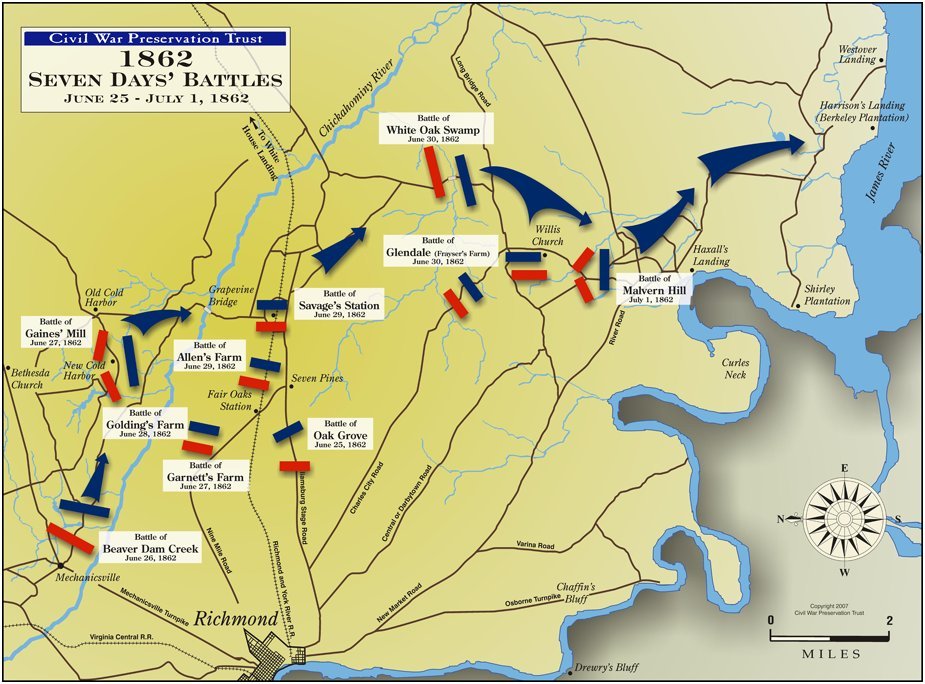
Battles The Seven Days Battles, which
concluded the Peninsula Campaign, consisted of the following battles: Oak Grove (aka French’s Field, King’s School
House), Beaver Dam Creek (aka Mechanicsville, Ellerson’s Mill), Gaines' Mill (aka First Cold Harbor), Garnetts & Goldings Farm, Savage's Station, Glendale (aka Nelson’s Farm, Frayser’s Farm, Charles City Crossroads, White
Oak Swamp, New Market Road, Riddell's Shop), and Malvern Hill (aka Poindexter’s Farm). June 25 On June 25, McClellan made
the first move. He planned to place his siege guns near a crossroads called Old Tavern. He would have to take Old Tavern by
assault, but to secure his left flank he first wanted the Confederates south of Old Tavern cleared out. To do this he dispatched
two divisions commanded by Generals Joseph Hooker and Philip Kearny from Samuel P. Heintzelman's Third Corps. Marching west
along the Williamsburg Road from Seven Pines, they ran into Confederate general Benjamin Huger's division near Oak Grove.
At first Hooker and Kearny made progress, but stiffening resistance and a flank attack halted them. By the end of the day
the lines were basically unchanged. News of the Union advance
left Lee concerned that McClellan was preparing a general assault. Lee's plans required McClellan to be passive. Only about
25,000 Confederates would be south of the Chickahominy, while about 65,000 would be positioned north of the river to attack
Porter. Jackson's men, marching east from the Valley, would not be in place until the morning of June 26, so as Lee was moving
his forces into place on the evening of June 25, a Union assault could create serious problems. In the end, though, Lee satisfied
himself that McClellan did not plan to attack and kept his plan in place. McClellan, however, heard of Jackson's approach
and called off Hooker's and Kearny's assaults on Old Tavern. June 26 As a result, much of June
26 was quiet. McClellan no longer targeted Old Tavern and Lee waited for Jackson. The Confederate general's plan counted on
Jackson's meeting up with Confederate forces on the Chickahominy River and relaying word to A. P. Hill, who, followed by forces
under D. H. Hill and James Longstreet, would cross the river, march through Mechanicsville, and attack Porter's Union corps,
which was positioned behind the waist-deep Beaver Dam Creek. Jackson was delayed, however, and at three o'clock, A. P. Hill,
along with a brigade from D. H. Hill's division, attacked anyway. Making it all the way to the creek, his men were turned
back by Union infantry and artillery. Weary from the long march,
Jackson and his men eventually arrived on Porter's flank, although it was too late in the day to make an immediate difference.
Still, his presence spooked McClellan, who determined that his supply line was too vulnerable. He also decided against an
attack south of the Chickahominy, despite outnumbering Lee by more than two to one there. Instead, McClellan ordered Porter
to hold a position behind Boatswain's Swamp while he prepared a "change of base"—in this case, a euphemism for retreat—to
the James River. June
27 In the morning the Confederates
north of the Chickahominy pursued the retreating Union army. Jackson and D. H. Hill moved northeast to turn Porter's flank,
and A. P. Hill and Longstreet moved southeast to fix Porter in place. But Lee thought Porter would stop behind Powhite Creek,
where Gaines's Mill stood, instead of Boatswain's Swamp farther east. So Jackson's movement did not turn Porter's position,
and A. P. Hill's assaults found the Boatswain's Swamp line fully as strong at Beaver Dam Creek. The Confederates charged throughout
the day to little effect until late in the afternoon when Jackson and D. H. Hill arrived. An uncoordinated but basically simultaneous
attack finally broke Porter's position. Confederates argued for years about who broke through first. John Bell Hood's 4th
Texas and part of the 18th Georgia usually took the honors, but actually Porter's line, although reinforced, yielded in many
places before the overwhelming assaults by the various Confederate units. South of the river little happened.
In the evening some of Confederate general John B. Magruder's men attacked the Union line near the Chickahominy at Garnett's
Farm but were repulsed. Later McClellan announced his move to the James. He then wrote a telegram to Secretary of War Edwin
M. Stanton that bitterly concluded, "You have done your best to sacrifice this army."
June 28 On the fourth day of Lee's
offensive, there was a lull as Lee waited to see what McClellan would do. Some of Magruder's Confederates attacked again near
Garnett's and Gouldin's farms, but with little result. On his way to the James, meanwhile, McClellan packed his trains, destroyed
whatever supplies he couldn't take with him, and burned White House Landing. (The fire took with it the historic house there.)
The artillery and two infantry corps moved to cover his retreat. That evening Lee gave orders
for the pursuit. John Magruder and Benjamin Huger would fix the Union rear guard in place. Stonewall Jackson and D. H. Hill
would cross the Chickahominy and stay north and east of the Union army. James Longstreet and A. P. Hill would circle around
the rest of the army to cut off the Union retreat. If all worked as planned, Lee could catch and destroy McClellan's army.
June 29 On June 29 Confederates
south of the Chickahominy River found the Union trenches empty and started their pursuit. Longstreet and A. P. Hill marched
twenty miles in the heat to be in position. But Huger received conflicting orders and spent his day marching. Jackson believed
he was to stay north of the Chickahominy instead of crossing the river and heading south and east as Lee had intended. Magruder
alternated between aggression and worry that Union troops would attack him, in part causing Huger's back-and-forth marching. Eventually Magruder attacked
the Union rear guard at Savage's Station, formerly McClellan's advance base. Union general Samuel Heintzelman continued his
retreat, leaving behind Union general Edwin V. Sumner's Second Corps and another division—more than enough troops to
stop Magruder despite an initial Confederate success. The rest of McClellan's army and the trains continued toward the James
during the day, and the rear guard followed that night. June 30 June 30 was the culmination
of Lee's pursuit plan. Despite the disorder of June 29, his pieces were in place for a glorious victory. McClellan kept more
than half of his army near the Glendale crossroads, which was vital to the retreat because most of the major roads from the
Richmond area to the James River converged there. Jackson and D. H. Hill would, by their presence, force the Union troops
guarding White Oak Swamp Bridge to remain north of Glendale, attacking them if possible. Huger would do the same on the Charles
City Road. Longstreet and A. P. Hill, joined by Magruder if the latter could move quickly enough, would then drive toward
the Willis Church Road south of Glendale to cut McClellan's retreat route. Once again Longstreet and
A. P. Hill performed well while the other generals struggled. Jackson contented himself with a bombardment at White Oak Swamp
Bridge, allowing thousands of Union troops to reinforce the Glendale lines. Huger's failure was on a smaller scale but just
as complete. Magruder spent June 30 as Huger had spent June 29, marching to no effect. So Longstreet and Hill attacked unsupported,
and broke the Union line initially before Union reinforcements made possible by Jackson's and Huger's failures pushed them
back. While the exhausted Confederates rested, the victorious Union troops joined the remainder of the army on the relatively
safe high ground at Malvern Hill. July 1 By July 1, the Army of
the Potomac had consolidated adjacent the James River. Its main line was on Malvern Hill, an eminence with a bluff overlooking
the river and an open, gentle north slope—perfect for defensive fire by artillery. It was the strongest position McClellan
occupied during the campaign. The Confederates followed slowly. Lee was cautious approaching an area he knew well from his
youth, and he determined only to attack if an artillery concentration proposed by Longstreet was effective. Although the Union
guns prevented such a concentration from taking place, the Confederates, through a combination of hope and bad orders, attacked
the Union line anyway during the afternoon and early evening. None of the several assaults came close to breaking through,
and most were stopped by the sheer power of the artillery, expertly handled by Colonel Henry Hunt, and fresh infantrymen brought
into line by Porter. For the fourth time in a week,
McClellan's men held the field during the day yet retreated at night—this time toward their new base at Harrison's Landing.
Aftermath On July 2 the Army of the Potomac
marched to Harrison's Landing in a driving rain. Lee followed the next day, having been alerted by Jeb Stuart that McClellan
had left Evelington Heights, a bluff commanding Harrison's Landing, unoccupied. But McClellan, perhaps reminded by Stuart's
shelling him with a single gun, moved troops to the heights before Lee could arrive. The Seven Days Battles had concluded,
and McClellan's best opportunity to take Richmond had vanished. From this moment on, the end of the war would likely mean
revolutionary change in the political and social fabric of the nation. The Seven Days Battles ended the Peninsula Campaign
but with a high cost. Both sides suffered heavy casualties. Lee's Army of Northern Virginia suffered about 20,000 casualties*
(3,494 killed, 15,758 wounded, and 952 captured or missing) out of a total of over 90,000 soldiers during the Seven Days.
McClellan reported casualties of about 16,000 (1,734 killed, 8,062 wounded, and 6,053 captured or missing) out of a total
of 105,445. Despite their victory, many Confederates were stunned by the losses. In the meantime, Confederate
spirits soared; despite a series of tactical defeats Lee had won a strategic victory, and he would keep the initiative until
September 17 along Antietam Creek near Sharpsburg, Maryland, where McClellan finally forced him to retreat. *Casualty figures for killed,
wounded, captured and missing vary slightly. The general consensus, however, indicates 20,000 Confederate casualties and 16,000
Union casualties. Analysis Seven Days Battles (June
25-July 1, 1862) was a series of battles in which a Confederate army under General Robert E. Lee drove back General
George B. McClellan’s Union forces and thwarted the Northern attempt to capture the Confederate capital of Richmond,
VA. McClellan was forced to retreat from a position 4 miles east of the Confederate capital to a new base of operations at
Harrison’s Landing on the James River. After the indecisive Battle
of Oak Grove (June 25), Lee’s attack on the Union right at Mechanicsville (June 26) was repulsed with great losses,
but Lee and General “Stonewall” Jackson combined to defeat General Fitz-John Porter’s V Corps in a bloody
encounter at Gaines’s Mill (June 27). In the battles of Peach Orchard and Savage’s Station (June 29) and Frayser’s
Farm (Glendale, June 30), the retreating Union forces inflicted heavy casualties on the pursuing Confederates. Reaching the
James River, and supported by Union gunboats, the Northern troops turned back Lee’s final assaults at Malvern Hill (July
1). Lee later stated in his official report that “Under ordinary circumstances the Federal Army should have been destroyed.” McClellan's plan probably
would have succeeded had Lee been willing to stand still for it. But the Confederate commander did not intend to let McClellan
fight that type of warfare. As he wrote to Jackson: "Unless McClellan can be driven out of his entrenchments he will move
by positions under cover of his heavy guns within shelling distance of Richmond." It was almost as if Lee had read McClellan's
letter to his wife. McClellan’s failure to
capture Richmond, and the subsequent withdrawal of the Union Army of the Potomac from the Yorktown Peninsula signified the
end of the Peninsular Campaign. Northern casualties were nearly 16,000 men and Southern casualties were
approximately 20,000. Coupled with his inaction to pursue Lee after Antietam, McClellan was removed from command by Lincoln.
General Lee, previously known as "Granny" Lee or King of Spades, now commanded the respect of the Confederate Army.
Sources: Burton, Brian
K. Extraordinary Circumstances: The Seven Days Battles. Bloomington: Indiana University Press, 2001. ISBN 0-253-33963-4; Burton,
Brian K. The Peninsula & Seven Days: A Battlefield Guide. Lincoln: University of Nebraska Press, 2007. ISBN 978-0-8032-6246-1;
Editors of Time-Life Books. Lee Takes Command: From Seven Days to Second Bull Run. Alexandria, VA: Time-Life Books, 1984.
ISBN 0-8094-4804-1; Eicher, David J. The Longest Night: A Military History of the Civil War. New York: Simon & Schuster,
2001. ISBN 0-684-84944-5; Esposito, Vincent J. West Point Atlas of American Wars. New York: Frederick A. Praeger, 1959. OCLC
5890637; Harsh, Joseph L. Confederate Tide Rising: Robert E. Lee and the Making of Southern Strategy, 1861-1862. Kent,
OH: Kent State University Press, 1998. ISBN 0-87338-580-2; Kennedy, Frances H., ed. The Civil War Battlefield Guide. 2nd ed.
Boston: Houghton Mifflin Co., 1998. ISBN 0-395-74012-6; Miller, William J. The Battles for Richmond, 1862. National Park Service
Civil War Series. Fort Washington, PA: U.S. National Park Service and Eastern National, 1996. ISBN 0-915992-93-0; Rafuse,
Ethan S. McClellan's War: The Failure of Moderation in the Struggle for the Union. Bloomington: Indiana University Press,
2005. ISBN 0-253-34532-4; Salmon, John S. The Official Virginia Civil War Battlefield Guide. Mechanicsburg, PA: Stackpole
Books, 2001. ISBN 0-8117-2868-4; Sears, Stephen W. George B. McClellan: The Young Napoleon. New York: Da Capo Press, 1988.
ISBN 0-306-80913-3; Sears, Stephen W. To the Gates of Richmond: The Peninsula Campaign. Ticknor and Fields, 1992. ISBN 0-89919-790-6;
Virginia National Battlefield Park; National Park Service; Official Records of the Union and Confederate Armies; National
Archives; Civil War Trust (civilwar.org).
Return to American Civil War Homepage
|
|
|
||||||||||||||||||||||||||||||||
|
||||||||||||||||||||||||||||||||||||
|
||||||||||||||||||||||||||||||||||||